Suggested Song: Le Sud, Nino Ferrer
Suggested Drink: Upside Down Martini: Vermouth, gin/vodka, olive.
I’m back in Aix and working from a new squat; a temporary flat rented from my former landlord, Emmanuel. The small unit is in a grand old building in the historic Mazarin quarter, kitted out in flea-market rococo, with creaky porte-fênetre French windows that open to a calm garden courtyard, fountain a’girgle. Provence charm.
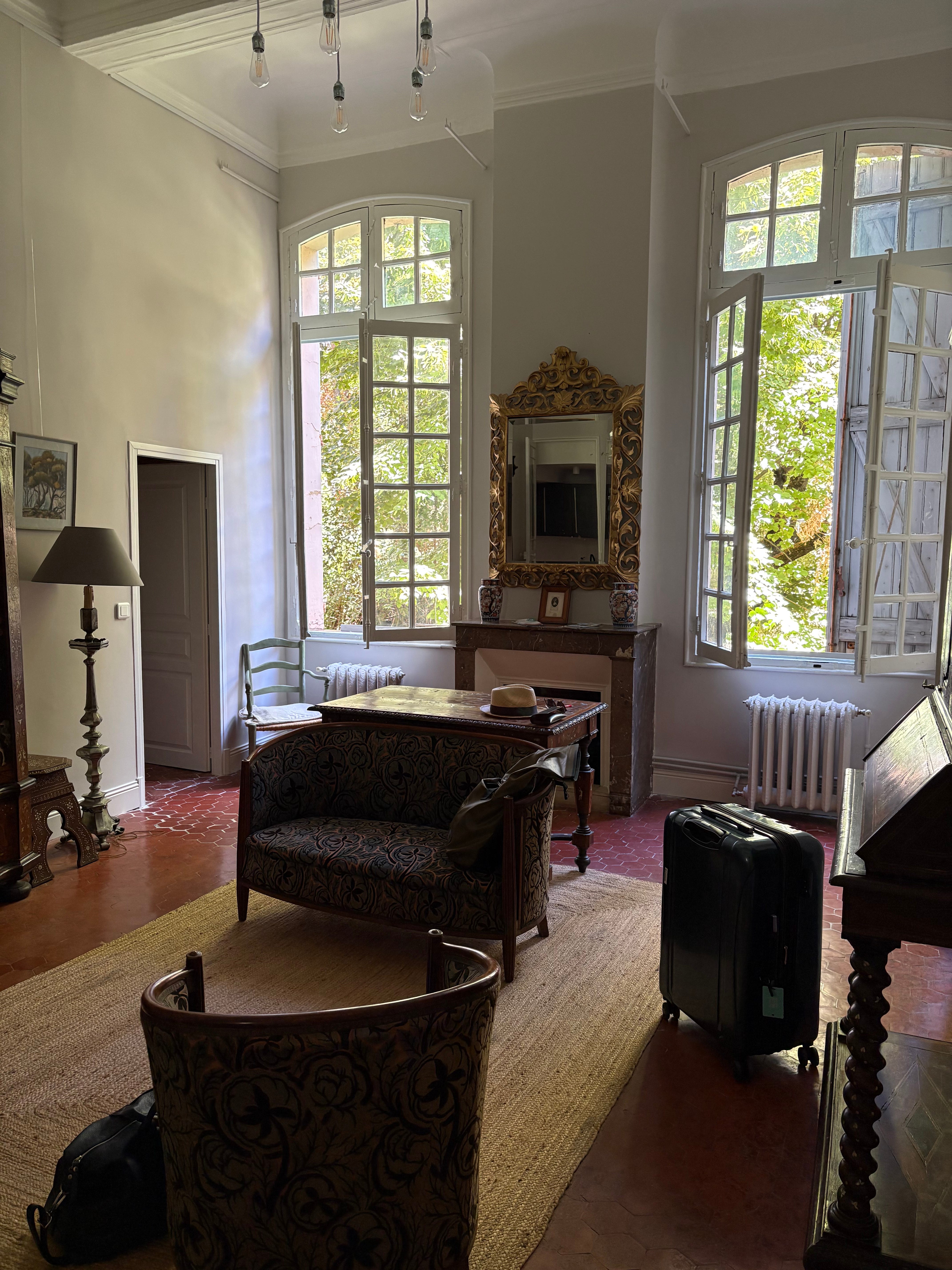
When typing away on a laptop here I imagine myself as the young Hemingway pecking furiously at his Underwood in Paris. Pretentious in the extreme, but it’s an image that pushes me to respect the process, to sit my ass in the chair and write, damn it. Delusions have their value.
I’m trying to have a creative few weeks during this stay – despite my holiday mindset – and so my thoughts are on process.
Top or bottom. How do you lean?
Some artists tackle the work-to-be-done in a bottom-up process, as if assembling a LEGO kit. A painter might experiment with a series of thumbnails, then commit to a drawing. Blocking in the major shapes and color values could follow, then mid-tones and background, followed by finer details and textures. A few more dabs here and scrapes there will finish the masterpiece, and then a sheen of varnish will lock it in.
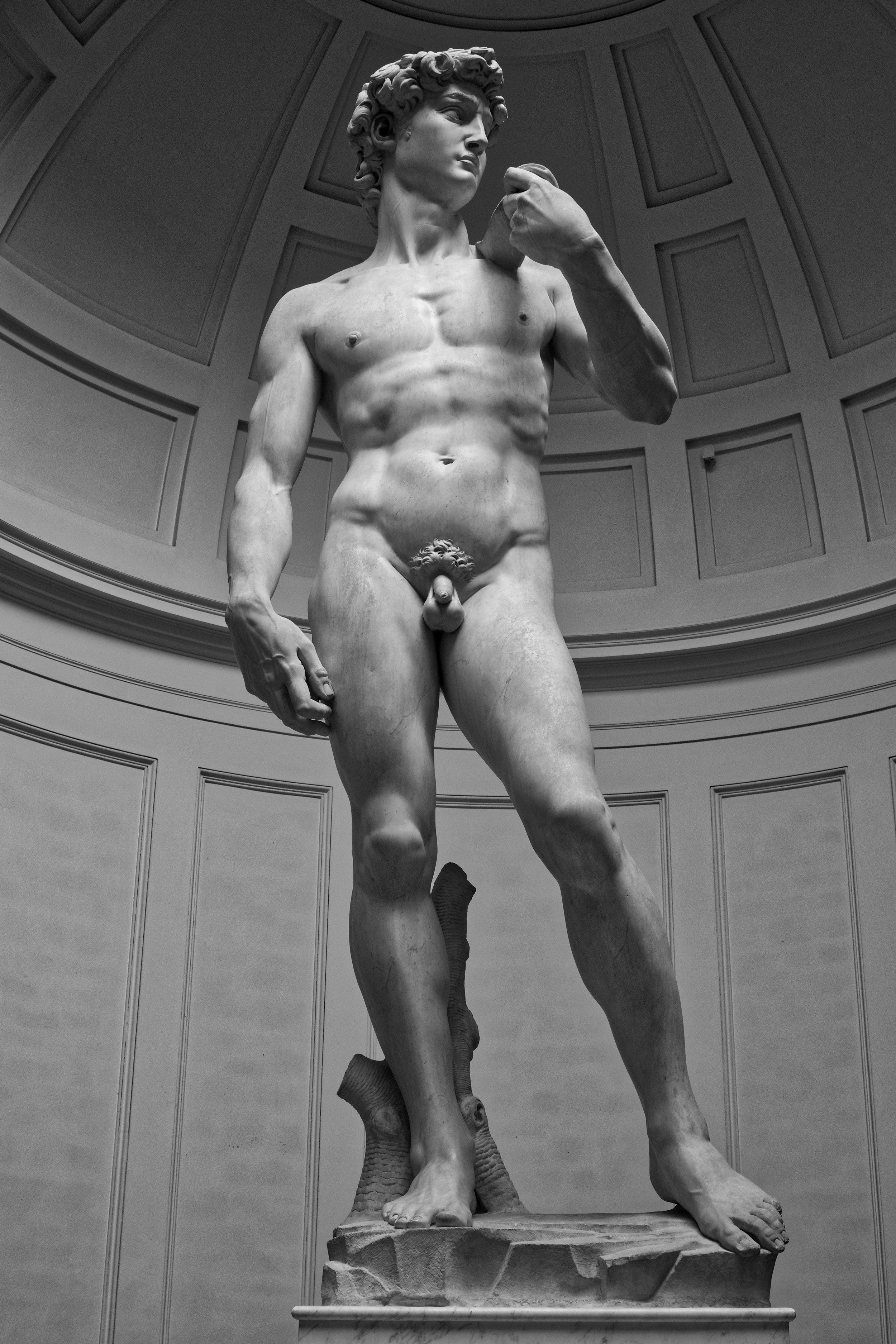
Others follow a top-down practice. Think Michelangelo and his David sculpture. Aside from a few crude drawings, he spent no effort on mock-ups, no plaster casts (an approach that Rodin favored). In 1501 Michelangelo stared up at single massive slab of Carrara marble almost 4 times his height, and with tools in hand got to work.
A good friend writes true crime novels. After reading everything he can find about the caper itself, he’ll assemble a mountain of background information on all things even remotely related to the incident: backgrounds on the crime-committing characters (and the crime stoppers pursuing them), a historic chronicle of similar incidences, psychological analyses of motivations underpinning said crime (why the heck do people do this?), the geography of the region(s), the time period, and so forth. Hundreds of books and journals and articles and records will be read, locations visited, and people interviewed. This exploratory period will take years and the repository of data will grow by month to Everest proportions. And then, with a tentative story arc in mind, the whittling-down begins. A first draft will be revised and tightened, revised and tightened ad nauseam, until his editor gives the final thumbs up.
Yeah, my pal is a total top. The final word count in his published book will be an order of magnitude less than the unwieldy starting point. Similarly, the floor of Michelangelo’s atelier in Florence was surely littered with more spent marble over 3 years of toil than twice the volume of the emergent David. (Pity his poor nightly cleaner. Oy vey!)
Get creative
There is compelling evidence that regular creative activities can strengthen a brain’s connections, enhance flexible thinking, and even produce biological brains that look years younger. (Click here to read more.) Creativity is as essential to the aging brain as play, as community, as sleep, as exercise, and as eating well.

You may not consider yourself creative. I’m calling bullshit on that. Everyone can be creative, even if not an artist. My brother is no artist (sorry Joe), but he looks at a massive block of dilapidated home and imagines a palace (where the rest of us just see a dilapidated home). Once acquired, he enters with sledge-hammer and drill and saw and takes it down to the foundational studs (great for anger management), then rebuilds it plank by board by crown molding in his own vision. Incredibly creative.
My own process varies. I’m working on a new song at the moment, and during these past weeks in Aix I’ve spewed out dozens of stanzas of mostly lame drivel. But through endless revisions I’m ferreting out a few tasty pearls, combining disparate lines and grabbing words from here to insert there. This top-down process of throwing everything up against the wall and then slowly rearranging is providing greater clarity on the arc of the song, its most powerful narrative, and the driving theme (which will be the futility of ambition; a theme that is so not me, and thus a delightfully wicked challenge).
Other times I work bottom up. I have a new musical script in development and I know exactly how the story will block out, the major and minor characters, the various plot twists and its dramatic ending. Now comes the finer details, the minor shades, the bit of texture that will take it from mildly amusing to the next Hamilton on Broadway. As stated above: delusions have their value.
If you struggle for inspiration or hit a wall, try switching up the process. Go bottom up if you’re a top-down type, or vice versa. (My gay friends in San Francisco will find that suggestion mischievously titillating.) Actually, most of us probably exist somewhere along that spectrum, not at the extreme ends.
A big thanks to Leia Immanuel, who helped guide my thinking on this piece. She’s bouncing around Europe this summer after just completing a BA in Art at Swarthmore, and was in Aix for a bit of Cezanne inspiration. We shared coffees. More on Leia and her art can be enjoyed here.
Bill Magill
Aix-en-Provence


Hey, I enjoy reading u. Hemingway.. I know more about his Cuban life. Lucky to have visited Havana multiple times. Glad and curious to hear that u r back
Many thanks, I haven’t been to Havana but hope to visit someday. Hemingway enjoyed quite the feast in Paris, but then I think he did most anywhere he set up the typewriter.
Garden of Eden…. Sexy south of France. Hemingway. Unusual book for him. I
It was indeed! Sexy – and very hot – south of France this summer!