Suggested Song: The Night Before, The Beatles Suggested Drink: Espresso Martini: vodka, Kahlua, espresso, simple syrup (good for the morning or night).
I’ve always been an early riser. Sometimes my work required it; mostly I just preferred it. This bias has become more ingrained with age. I’m usually up before dawn now, and winding down shortly after dinner. I used to fight it, now I lean into it. The agency of aging.
I love running before daybreak. The San Francisco air is fresh, the streets are empty, and the quiet calm reveals an urban temperament most locals would not recognize. In my Civic Center neighborhood the morning commute will soon fill the air with a cacophony of beeping horns and lurching buses and a start-stop rhythm of red-light traffic flows. The sidewalks will bustle with coffee-clutching bobbleheads talking loudly to no one while rushing to work. The homeless emerge, dog walkers get fido out for the morning poop, and the F Line street cars start clanging their way up and down Market Street. It’s a radical contrast with the moonlit serenity I enjoyed just an hour earlier.
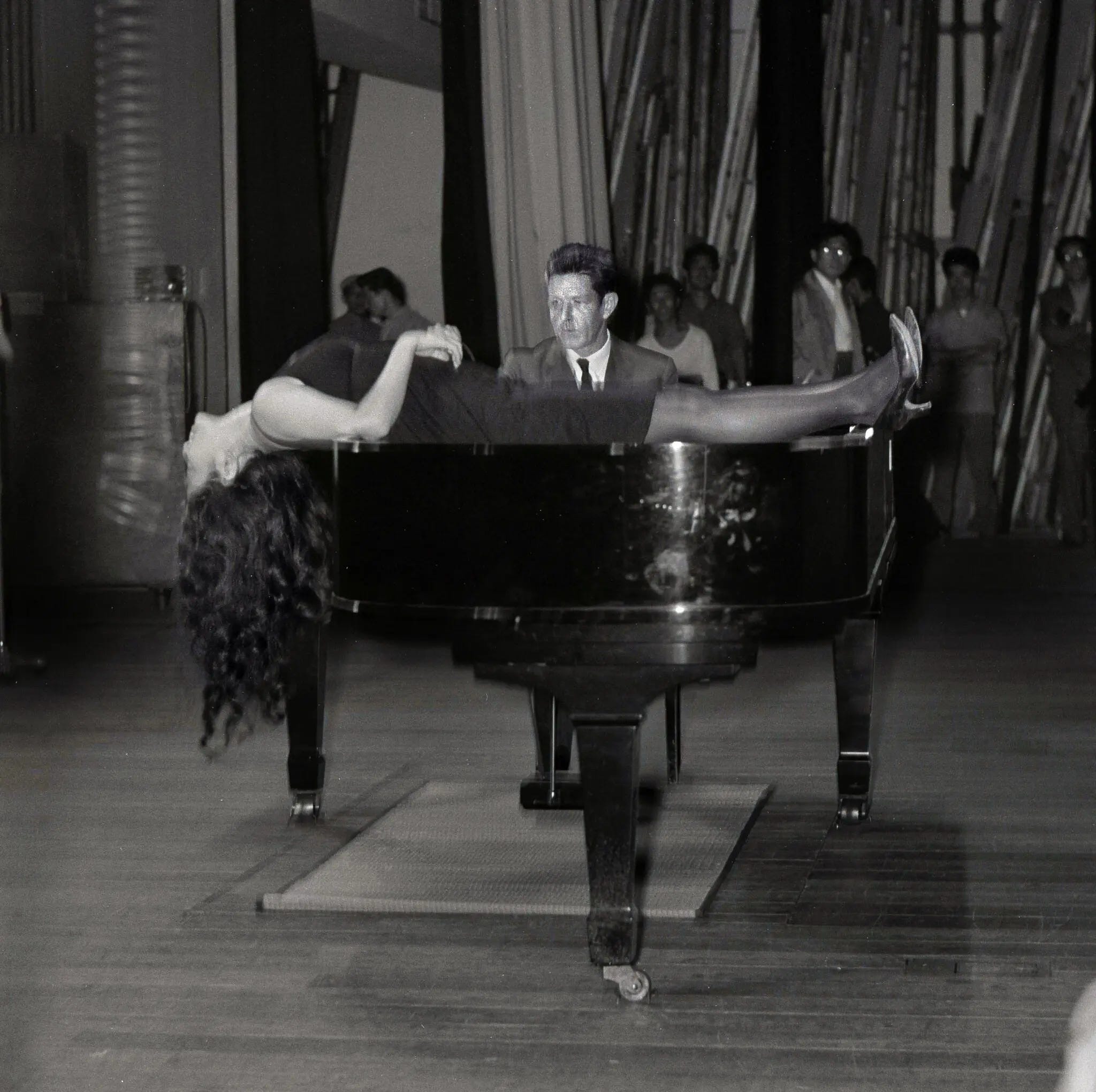
Photo by Craig Lee, San Francisco Examiner.
Aix-en-Provence is different but the contrast no less distinct. French tourist towns rise early. The streets may feel sleepy but a lot’s happening behind the curtain. Boulangiers are rolling out dough and firing up ovens well before sunrise. The cafes along the grand Cours Mirabeau won’t open for another hour of two, but the pre-shift is already setting up terrace tables and chairs as I jog by in the dark. Aix’s sidewalks and alleys enjoy a pre-dawn hosing down, while loud sweeper trucks bristle past. (Aix hint: never rent along the Cours. Oh, those apartments above street level look elegant with their high windows and long views down the tree-lined promenade, but the early morning noise? Infernal.)
By 8 a.m. Aix will be humming with a different sort of species. The morning shoppers with straw baskets (paniers) will be getting first picks at the farmers markets in the Richelme or Prêcheurs plazas; the bread-crazy French will be queuing at boulangeries for baguettes and croissants and pains au chocolat; and the cafe tables will start filling up with cigarette-smoking, espresso-sipping locals, and a few early-rising vacationers puzzling over coffee options. (A market merchant or 2 will likely be enjoying a fortifying half pastis or rosé before the rush.)
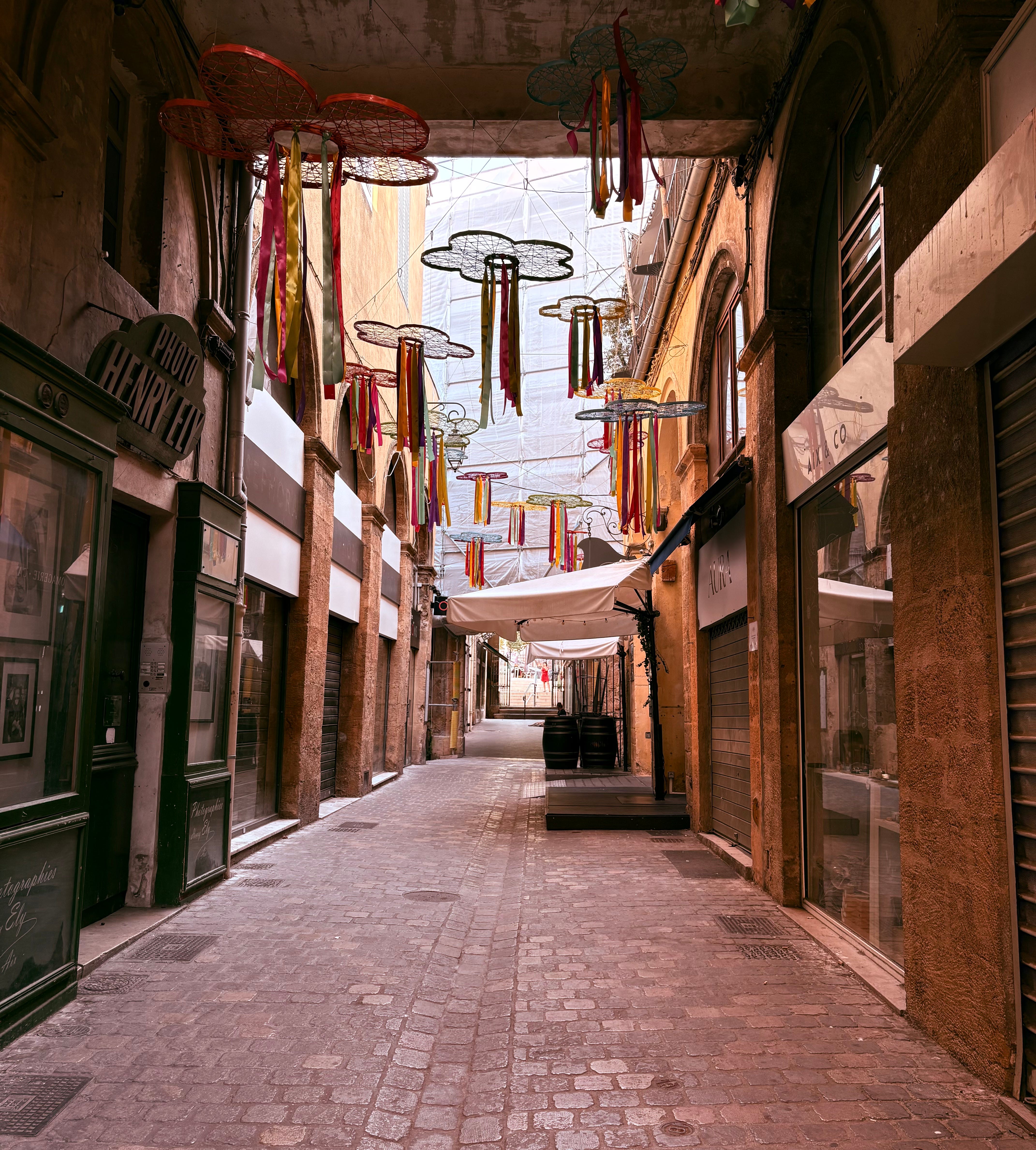
The Passage Agard in Aix-en-Provence, before the crowds get moving.
My friends are mostly night owls, not morning larks. Their productive hours start later in the day and run into the evenings. Stay up until midnight writing or gaming or watching Netflix? No problem. Sleep in until 9 a.m. or later? Even better.
If we plan a night out, even an impromptu same-day plan, I will rally, but those mid-evening calls – hey, we’re all down at the Forum, what are you up to old bean? – go straight to voicemail these days. I am starting to enjoy my clear mornings more than my cloudy nights, and honoring that shift. The agency of aging.
There’s good reason to fix a night/morning schedule, whether you’re a lark or an owl. The health benefits of getting a solid sleep are well documented – heartier immune system, happier emotions, healthier brain – and a hack for said sleep can be found in honoring a set bedtime, be it early or late. This is harder to follow when we’re young, horny, and expanding our social networks (At the Forum now? I’ll be right down.). But those priorities yield to a different set with age. (If curious to read more about the complex world of sleep, Why We Sleep remains the touchstone on the topic.)
A 2024 study by Imperial College indicates that night owls operate at higher cognitive levels than morning larks. But Bryan Johnson, the popular lifemaxxer, insists that the sweet spot, at least for him, is around 8:30 p.m. to 4:30 a.m. Lots of conflicting opinions and data, but you have agency. So what’s your birdcall?
Suggested Song: Le Sud, Nino Ferrer Suggested Drink: Upside Down Martini: Vermouth, gin/vodka, olive.
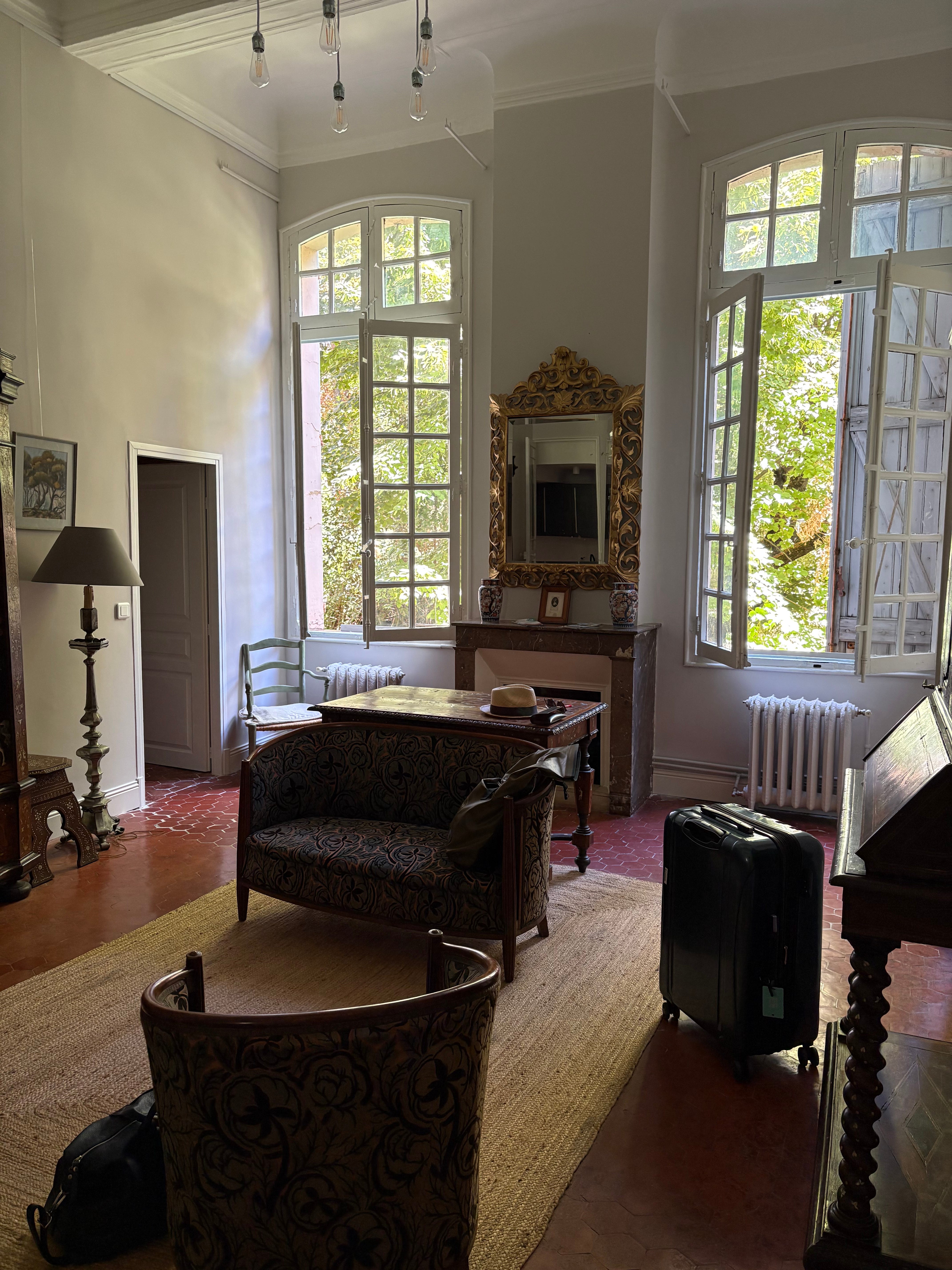
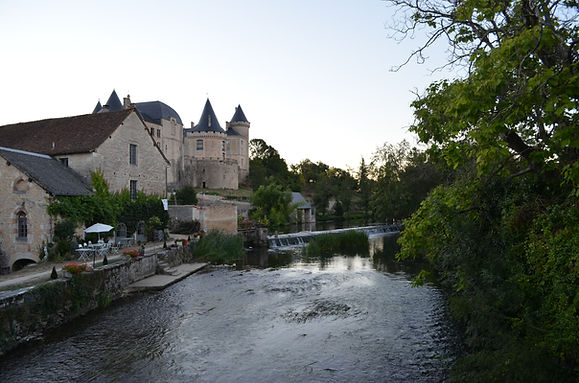
I’m back in Aix and working from a new squat; a temporary flat rented from my former landlord, Emmanuel. The small unit is in a grand old building in the historic Mazarin quarter, kitted out in flea-market rococo, with creaky porte-fênetre French windows that open to a calm garden courtyard, fountain a’girgle. Provence charm.
Slumming it in Aix-en-Provence.
When typing away on a laptop here I imagine myself as the young Hemingway pecking furiously at his Underwood in Paris. Pretentious in the extreme, but it’s an image that pushes me to respect the process, to sit my ass in the chair and write, damn it. Delusions have their value.
I’m trying to have a creative few weeks during this stay – despite my holiday mindset – and so my thoughts are on process.
Top or bottom. How do you lean?
Some artists tackle the work-to-be-done in a bottom-up process, as if assembling a LEGO kit. A painter might experiment with a series of thumbnails, then commit to a drawing. Blocking in the major shapes and color values could follow, then mid-tones and background, followed by finer details and textures. A few more dabs here and scrapes there will finish the masterpiece, and then a sheen of varnish will lock it in.
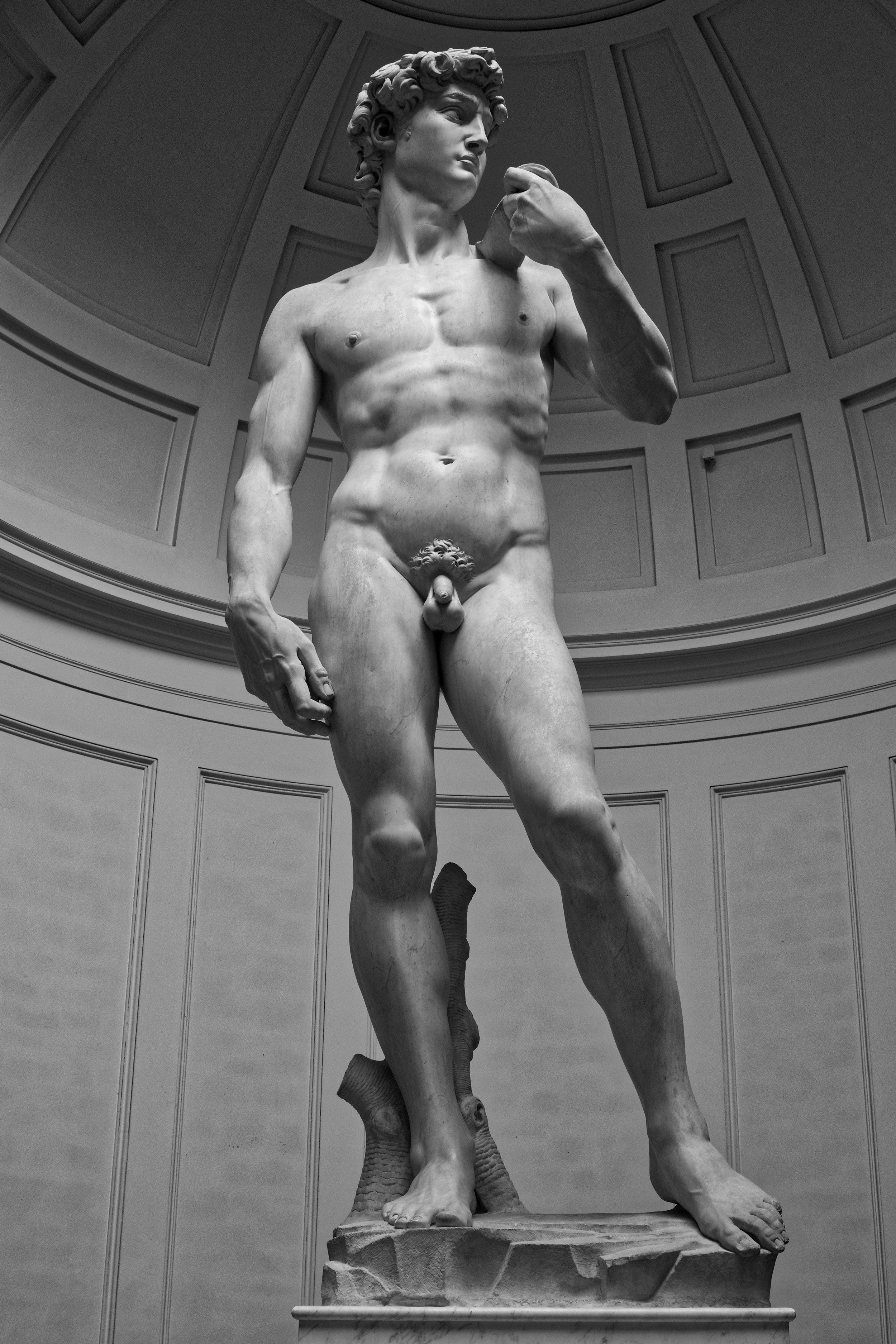
Michelangelo’s David. Photo by Jim Nix.
Others follow a top-down practice. Think Michelangelo and his David sculpture. Aside from a few crude drawings, he spent no effort on mock-ups, no plaster casts (an approach that Rodin favored). In 1501 Michelangelo stared up at single massive slab of Carrara marble almost 4 times his height, and with tools in hand got to work.
A good friend writes true crime novels. After reading everything he can find about the caper itself, he’ll assemble a mountain of background information on all things even remotely related to the incident: backgrounds on the crime-committing characters (and the crime stoppers pursuing them), a historic chronicle of similar incidences, psychological analyses of motivations underpinning said crime (why the heck do people do this?), the geography of the region(s), the time period, and so forth. Hundreds of books and journals and articles and records will be read, locations visited, and people interviewed. This exploratory period will take years and the repository of data will grow by month to Everest proportions. And then, with a tentative story arc in mind, the whittling-down begins. A first draft will be revised and tightened, revised and tightened ad nauseam, until his editor gives the final thumbs up.
Yeah, my pal is a total top. The final word count in his published book will be an order of magnitude less than the unwieldy starting point. Similarly, the floor of Michelangelo’s atelier in Florence was surely littered with more spent marble over 3 years of toil than twice the volume of the emergent David. (Pity his poor nightly cleaner. Oy vey!)
Get creative
There is compelling evidence that regular creative activities can strengthen a brain’s connections, enhance flexible thinking, and even produce biological brains that look years younger. (Click here to read more.) Creativity is as essential to the aging brain as play, as community, as sleep, as exercise, and as eating well.
From Creative Experiences and Brain Clocks, Nature Communications, 2025.
You may not consider yourself creative. I’m calling bullshit on that. Everyone can be creative, even if not an artist. My brother is no artist (sorry Joe), but he looks at a massive block of dilapidated home and imagines a palace (where the rest of us just see a dilapidated home). Once acquired, he enters with sledge-hammer and drill and saw and takes it down to the foundational studs (great for anger management), then rebuilds it plank by board by crown molding in his own vision. Incredibly creative.
My own process varies. I’m working on a new song at the moment, and during these past weeks in Aix I’ve spewed out dozens of stanzas of mostly lame drivel. But through endless revisions I’m ferreting out a few tasty pearls, combining disparate lines and grabbing words from here to insert there. This top-down process of throwing everything up against the wall and then slowly rearranging is providing greater clarity on the arc of the song, its most powerful narrative, and the driving theme (which will be the futility of ambition; a theme that is so not me, and thus a delightfully wicked challenge).
Other times I work bottom up. I have a new musical script in development and I know exactly how the story will block out, the major and minor characters, the various plot twists and its dramatic ending. Now comes the finer details, the minor shades, the bit of texture that will take it from mildly amusing to the next Hamilton on Broadway. As stated above: delusions have their value.
If you struggle for inspiration or hit a wall, try switching up the process. Go bottom up if you’re a top-down type, or vice versa. (My gay friends in San Francisco will find that suggestion mischievously titillating.) Actually, most of us probably exist somewhere along that spectrum, not at the extreme ends.
A big thanks to Leia Immanuel, who helped guide my thinking on this piece. She’s bouncing around Europe this summer after just completing a BA in Art at Swarthmore, and was in Aix for a bit of Cezanne inspiration. We shared coffees. More on Leia and her art can be enjoyedhere.
Suggested Song: San Francisco, Scott McKenzie Suggested Drink: Chinese Mai Tai at the Li Po Lounge (Dark and light rum, pineapple juice, and a mysterious “Chinese liquor”).
I’ve been delinquent in getting a new essay out since arriving in San Francisco. A change in amoureux messes with one’s creative rhythms, and while an urban divorce with visitation rights had been my plan, I’m quickly accepting the flaws in my thinking. What’s Plan B?
I am vexed by 2 lovers. When in San Francisco I long for the warm embrace of Aix-en-Provence. When in Aix I miss the urban energy of San Francisco. Both are real seducers but distinct encounters. One is a bustling ball of creative kinks and diversity, the other a charming postcard of Provençal splendor. One, an impatient center of bleeding edge what’s next and its innovators, the other a revered destination for the good life now and its disciples. If San Francisco is a stalking tigress in black leather, Aix is a demure gazelle in white linen.
Their distinctions can be contrasted as much as anything through food. San Francisco is the definition of culinary range. The Inner Sunset (my current squat) offers menus of French, Singaporean, Korean, Chinese, Japanese, Eritrean, Italian, Mexican, El Salvadorian, Persian, Moroccan, Greek, and other cuisines packed around the buzzing 9th and Irving core. Banh mi, pho, glass noodles, kitfo, street tacos, sushi, ceviche, pizza, … what’s for dinner tonight? This neighorhood puts my tastebuds in hyperdrive.
Korean BBQ short ribs (Kal Bi) at Manna, the Inner Sunset, SF.
Aix is a totem of French exceptionalism. The small Mediterranean city has over 40 boulangeries, most packed into the dense centre-ville. Some, such as Farinoman Fou or Hat’s, are considered among the best in France. The daily open air markets overflow with local Provence produce and flowers, honey and lavender. The rich sights and sounds and smells consume the senses. Okay, I surrender, give me a few of those. Yes, you can find flaky croissants and bustling farmers markets in San Francisco. No, as anyone from France will tell you, n’est pas pareil (just not the same.)
I have come to realise that neither affair will ever satisfy completely. A clean Provence break is not possible, nor is resisting San Francisco. The only solution is an open metromarriage, a polyurban arrangement, and that challenge is giving me purpose. Stay tuned.
An aside on big moves: the merits of patience and acceptance
With any audacious endeavor comes challenge, and this move-my-life-back-to-SF adventure has had its hiccups. I’m honing 2 virtues to cope: patience and acceptance. With a bit of effort we eventually get mostly what we need, and when we don’t, … well we can learn to roll with it.
My master plan for reentry went something like this: get reacquainted with the city (it’s been 15 years), optimize on a neighborhood, close on an apartment, fill it with stuff, find your groove.
It turns out I’ve landed into one of the tightest and most expensive housing markets in the country. (That whole doom loop thing? Yeah, that was so post Covid. Try to keep up.) Complicating matters, unlike the nouveau riche swarm of AI techies I don’t have a regular salary 3x the exorbitant rents (medium monthly for a 1 bedroom is now $3,670 as of this writing), and my US credit history is a blank page, having been in France for almost 2 decades.
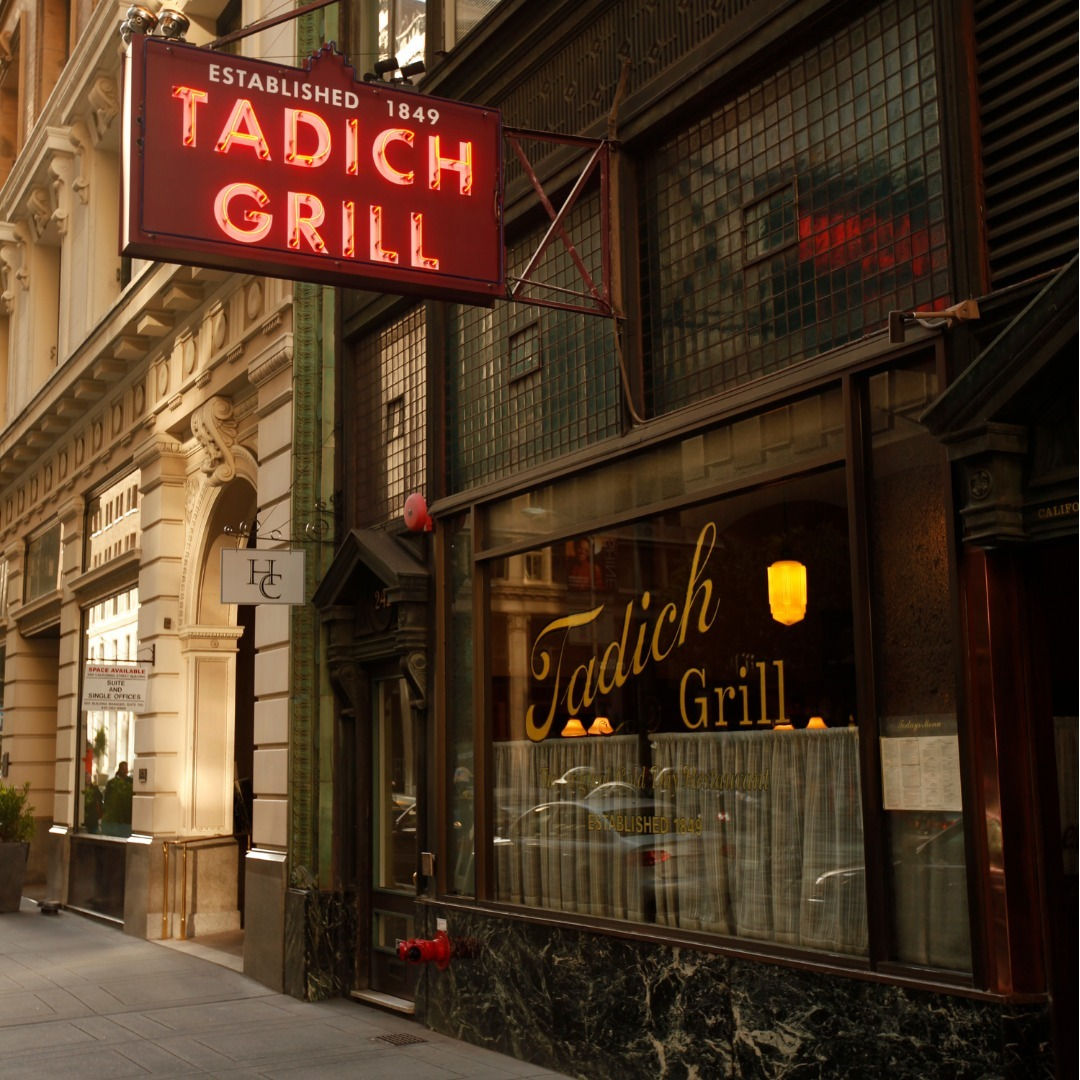
I am getting to know San Francisco again, visiting old haunts like Mario’s Bohemian and the Tadich Grill, and finding new favorites, like Chez Maman in Hayes Valley (soon to be my permanent quartier). The neighborhoods I had optimized on have become p.r.i.c.e.y (!) and the spacious Victorian flat I imagined, … suffice it to say that expectations have been recalibrated. This took a lot of unit visits to appreciate (patience) and humility to absorb (acceptance). All good.
The Tadich Grill on California Street, SF. California’s oldest restaurant.
So, I have found my new neighborhood and home, a downtown high-rise apartment along bustling Market Street. Not the charming urban village I had imagined when starting this journey, but we have to be flexible; another virtue that has come in handy. Now the fun part: finding that new groove of favored cafes, restaurants, bars, parks, strolls, and flirtations that will color my days and evenings. The tender touch of Aix has spoiled me damnit. Onward!
Suggested Song: Take Me to the River, Al Green Suggested Drink: AIX Rosé (A masterclass on global wine marketing.)
“The greatest thing in this world is not so much where we stand as in what direction we are moving.” – Johann Wolfgang Von Goethe
I arrived in Aix-en-Provence in the fall of 2010. My son Jess arrived a month later and the twins the following year. It was the start of an era: the Aix-en-Magill years. As I close out this chapter and prepare for the movers, the nature of our eras begs for a glass of wine and a few words.
First contact
Kids can be our greatest ambassadors when arriving in a new town, especially as strangers in a strange land. They make first contact. We meet other parents through their new-found friendships. We enjoy culture-shock group therapy in the school parking lot, waiting for a pick-up. We convene for boozy dinner parties and let our kids run wild for a few hours, comparing their rascally behaviors like pirate scars. Oh you think your kid’s a handful? These engaging new friendships are chicken soup for the wandering soul and soften the landing.
Just another summer afternoon with friends in Aix-en-Provence.
A testament to the intimacy of bonds amongst true compadres is through the naming convention of said friends. Last names trump first names and nicknames trump them all, once that deep familiarity is reached. Each term of endearment holds a history. Chairman of the Board; the Bean; Max the Swede and Canadian Dave; Bongos Eddy and Dada, Parker and Finkel and Magill. In all cases the wives were equally as amusing (and kids suitably troublesome).
In time the kids grow up. Some ask to finish their high-school years back home, their parents dutifully join them, and an era winds down. This is the nature of expat communities: a constant churn as new families arrive and others bid their adieus. It can touch the left-behinds with melancholy, but also provoke a healthy consideration of next moves, to evolve in our own ways and not go stale. I’m beginning to feel stale. My 3 Magill bumpkins have taken root in California. I miss San Francisco. And so I’m moving on.
Let if flow
Life is not an immortal home set on a solid foundation. It is a Huck Finn raft floating down a mighty river. We have a rudder and some (self-deceiving sense of) control, but the current ultimately decides. The wide stretches are slow and calm, the narrow rapids exhilarating. Some inflowing channels, like new friends, sweep us on ahead, and some outflows pull us down unplanned bearings.
The serene Charente River, near my brother’s home in France.
And so it is with eras. There are feeding streams and swirling eddies and new water churning with the old constantly. I mingle with the new and old here in Aix, some arrivals diving into a fresh era, others rewinding to a more contained stasis. We can be part of all of these, but our own personal eras remain singularly unique. We must lean into them, draw great comfort from them, and know when to let them go.
To my loyal readers, I am in the process of consolidating websites and this particular one has its days numbered. The primary page for my essays, those copied here, will remain at Substack. You may want to follow me there, at no charge (ever).
Is there any greater comfort than being home? Perhaps your humble hearth is not as Conde Naste as a sun-kissed villa in Tuscany, nor as opulent as a rambling compound in Calabasas. But it is infinitely cozier and more familiar, regardless of placement and volume. When feeding the soul in slippers and pjs, we just want to be home.
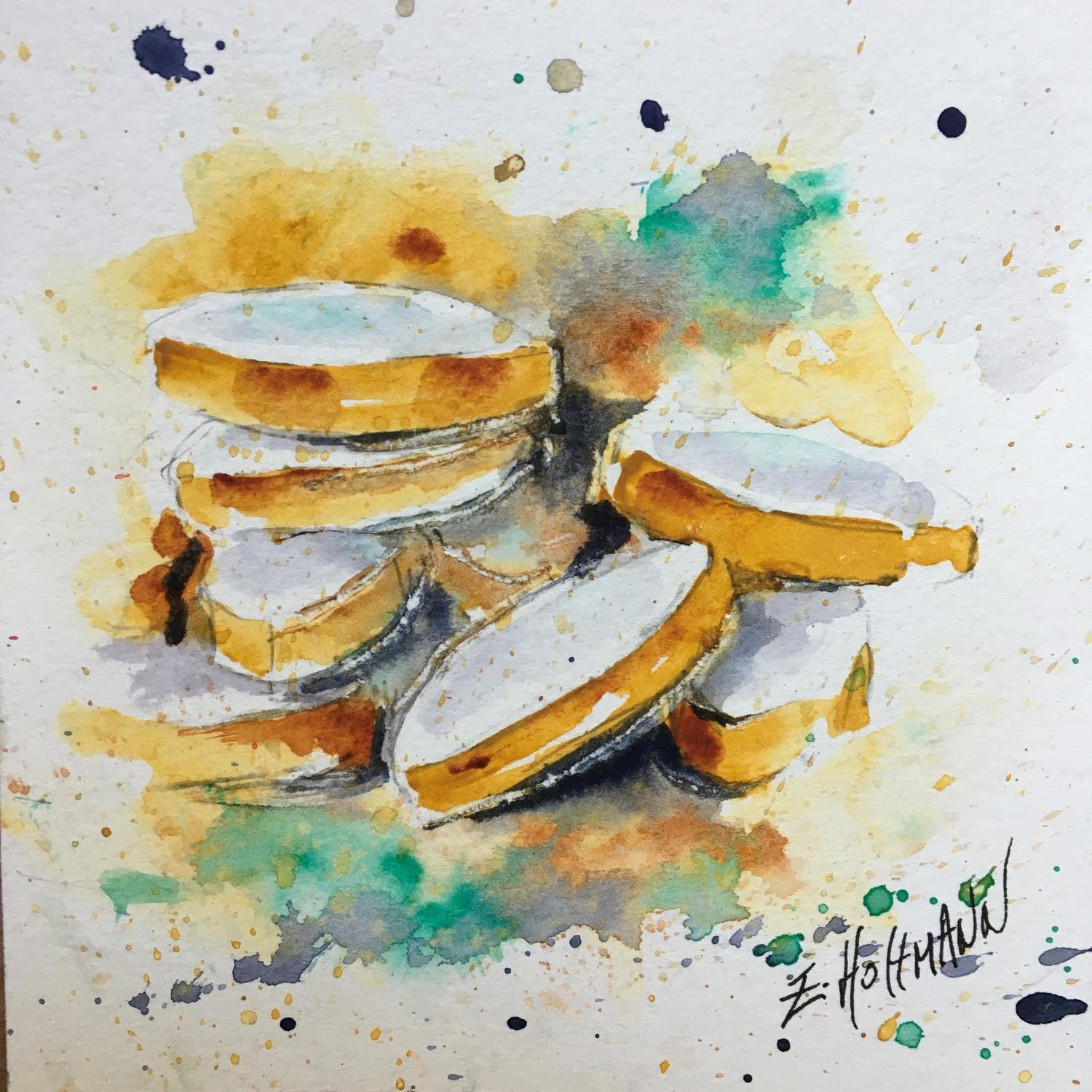
I’ve lived in a 2 bedroom flat in Aix-en-Provence since 2010. By American standards it’s humble in size but rich in character. Constructed about the time Columbus was bobbing around the Bahamas, my apartment’s high-beamed ceilings and terracotta floors evoke a genteel period when Aix was the parliamentary center of the greater region. Think powdered wigs and bodice tops, ripe for the ripping (as Flaubert would have us believe). While deliberating the Sun King’s impending visit from Versailles, my airy salon may have hosted a gaggle of countesses (that sounds sexist) nibbling on candied almond calissons and sipping fine champagne, pinkies extended most delicately. Okay, who’s doing the flower arrangements?
Huit Calissons d’Aix, by Elisabeth Hoffmann.
One’s home is more than a collection of rooms plus roof for the rain. It is our private refuge and space for healing. It is our expression of self. Photos there speak of family and friends and favorite holidays. Kitchens there feed loved ones. When the day is done and dishes put away, we lever back the recliner, dip the tea bag, open the novel or click on the remote. Ahhh, home.
The comforts of home are top of mind now (in my small brain), for 2 reasons.
#1: The flux of the world.
More than 120 million people worldwide are currently displaced from the sanctuary of home, according to the UN, a 6 percent uptick from the year before. That includes a full quarter of the Syrian population, Ukrainians and Afghanis by the millions, and refugees from dozens of countries across the planet too numerous to list. Despite the varying conditions for their transient lodging, from spare rooms to squalid camps, one sentiment is shared: a deep longing for home.
Add to that count two million Gazans, who have been hounded south, then chased north, then south again, and to where next? As of August, an estimated 92 percent of all homes in the strip lay in ruins, former occupants either dead or starving in tents. It’s thought that 49 of the Israelis kidnapped on October 7 remain hostage and alive (is that the word?) in the dark tunnels underground. All longing deeply, deeply for home.
That this purge would take root in the US was unimaginable just months ago. Now that root has taken, and with a flourish. As of the summer, ICE has detained 60 thousand undocumented immigrants (70% of which have no criminal records) for eviction. Stephen Miller’s stretch goal is one million per year (quite the ambitious Nazi), and ICE is tripling the number of agents by year-end to hit his quota. That’s a million moms, dads, sons and daughters, deeply knit into our communities’ fabrics, taken from their homes and given the boot. Last night was lemonade and T-ball in the neighorhood cul-de-sac. Tonight its suitcases and cots in a distant detention center. Like the Ukrainians and Palestinians and so many more, they will soon be crying for home.
The “worst of the worst” being rounded up in Camarillo, California, June 2025.
#2: The flux in my life: I’m leaving home.
Aix-en-Provence will be in my rearview come December, after 15 years of amazing joy and discovery here. More on why in coming Postcards, but I will surely miss this flat, its comically uneven floors, the drafty tall windows, its cheap kitchen appliances (that produced some stunning meals through the years), the family photos here and books stacked there, my daughter Stella’s daybed in the living room corner, and the faux antique tables and stands bought for a dime from the local flea market. (My sons and I lugged more of that stuff up the wide promenade through Aix than I care to remember. What, pay for delivery?)
I’m leaving on my own terms, taking what I want, and heading where I decide (back to San Francisco, of course). This is my home and I’ll miss it, probably long deeply for it when reading this article or seeing that show about Provence. But it’s my call and I can return when I want. How blessed is that in today’s world? Don’t catch me crying.
Suggested Song: Starry Starry Night, Don McLean Suggested Drink: Pastis: … just add water (the official drink of Provence)
“When you’re born there, it’s hopeless, nothing else is good enough.” – Paul Cézanne (referring to Aix-en-Provence.)
Cézanne is THE son of this city. Other great artists have called it home (Émile Zola and Bill Magill, as fine examples), but none attained the level of acclaim and continued adoration of our good friend Paul. And for that he’s being celebrated this summer with exhibits and events in Aix.
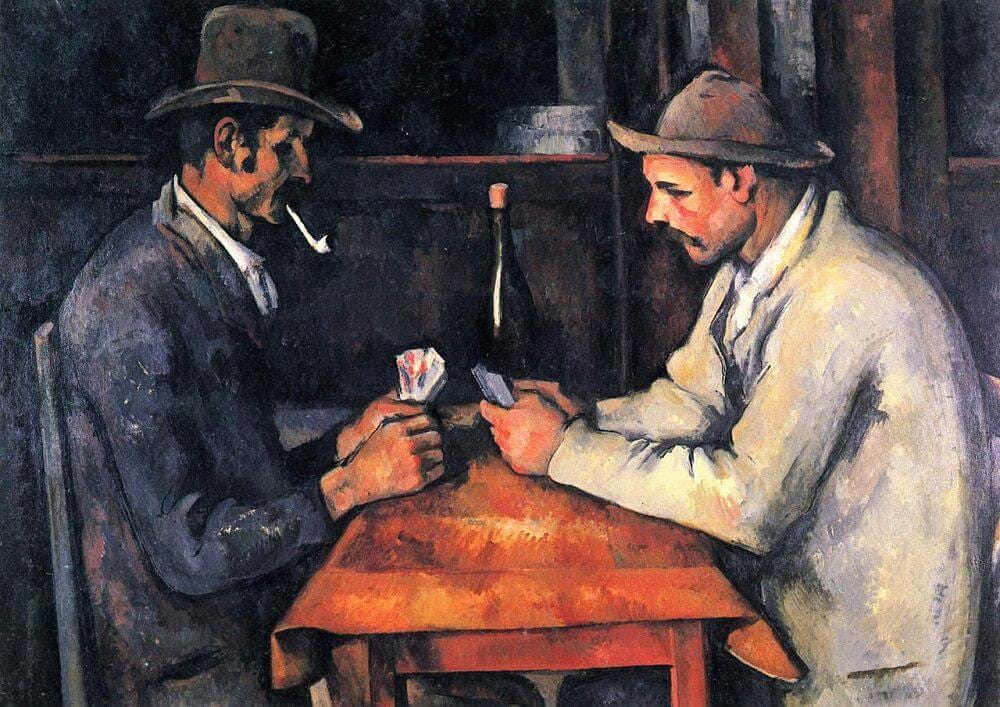
I’ve often considered Cézanne’s peerless renown over my years in Aix, tracing his steps through town (the favorite haunts are marked with sidewalk-embedded badges) and lingering over his works in the modest, local Musée Granet. In 2012, the royals from Qatar paid north of $250 million for his The Card Players, making it the world’s most valuable painting at the time. (Did they realise he painted 3 versions? Suckers!)
The Card Players, Paul Cézanne (version #3)
My appreciation of art is recreational at best. I do like Cézanne, but love Van Gogh. Vincent, too, tumbled hard for the soft yet vivid hues of Provence, doing his most celebrated works in Arles (the ear cutting) and Saint-Rémy (the asylum sleeping). Maybe it’s the drama queen in me that is roused so deeply by the hallucinatory Starry Night, painted before a summer sunrise in 1889 from his asylum window.
A tortured artist Cézanne was not, but radically trailblazing, and considered the creative leap through which impressionist water lilies met cubist taureaux. Picasso and Matisse are both said to have called him “the father of us all,” and the English curator Lawrence Gowing submits that Cézanne’s daring work with the knife pallet introduced “the idea of art as emotional ejaculation.” (I’m committing that phrase to memory.)
But this isn’t an essay about one man’s genius.
What I find most fascinating about Cézanne’s story is not his meteoric impact on 19th century art, but the spooky threads of style and concept that connect this artistic evolution to his trailblazing contemporaries in other disciplines of the same period, such as literature, music, science, mathematics, and dance.
An argument can be made – and ChatGPT makes it here more succinctly than me – that the creative pioneers of this period shared Cézanne’s obsession with:
Subjectivity and perception. Cézanne wasn’t just painting what he saw, but how he perceived the subject of his gaze.
Fragmentation and reconstruction. He broke forms first into geometric shapes, and then reconstructed them wholly reimagined on canvas.
The essence of things. Cézanne placed a higher emphasis on the underlying essence of objects than the mere surface appearances.
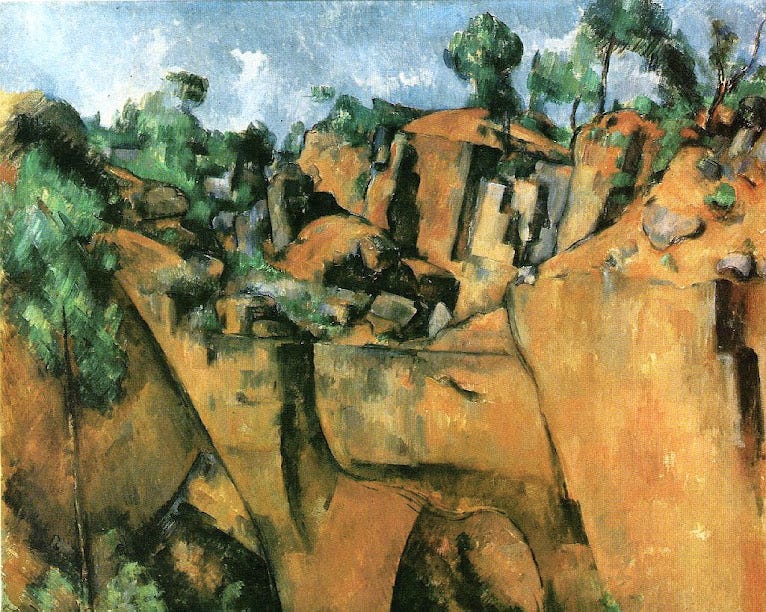
Bibemus Quarry, Paul Cézanne
And so I prompted my trusted assistant further to offer examples that amplify my Wednesday afternoon art-of-distraction epiphany of inspired interdisciplinary connections. And this they/them told me:
On literature, “Marcel Proust’s ‘In Search of Lost Time’ is almost exactly the literary equivalent of Cézanne. He broke from traditional narrative structures and focused on subjective experience, memory, and the reconstruction of reality through fragments of sensory detail.”
On music, “Claude Debussy moved away from traditional harmonic structures in music. Like Cézanne, Debussy was creating atmosphere and evoking emotions through suggestion rather than direct statement.”
Listen to Rêverie, by Debussy:
On philosophy, “Henri Bergson’s philosophy of duration aligns with Cézanne’s attempt to capture the essence of objects over time and through multiple perspectives. He emphasized intuition and subjective experience as ways of knowing the world.”
On dance, “Isadora Duncan rejected the rigid formality of classical ballet, seeking a more natural and expressive form of movement. She was after something real and less contrived, as was Cézanne.” Watch Duncan dance here.
Additionally, math and science became increasingly abstract through the 19th century, with the introduction of complex numbers and the theory of entropy, holding that every system in the universe inevitably trends toward disorganized states. (One look at my son Shane’s bedroom, during his teenage bedlam years, was convincing proof that the theory of entropy was holding up well.)
But this isn’t even an essay about spooky threads in a temporal creative plane. This is a meandering stream-of-consciousness lazy summer arc about the much-debated merits of higher education in 2025. Stay with me, we’re almost done.
At the University of California, Davis I studied physics (major #1) and economics (major #2), to which I pivoted after making first contact with the mental horsepower required to complete major #1. (Also, the hottest girls on campus were on the liberal arts side of the Quad.) Davis was a fantastic school with an amazing faculty, and I learned a lot in both departments. But it wasn’t the core courses that marked me most deeply, nor made me a more interesting Bill. It was in the wildly obtuse electives in which I chose to enroll: Altered States of Consciousness; Mexican History; Film Appreciation, Wine Tasting, and (most relevant to this essay) a course that extended the oft-discussed creative parallels between Picasso and Stravinsky to the works of Max Plank, Sigmund Freud, Samuel Beckett, Alberto Giacometti, and John Cage. This course blew . my . fucking . mind. As my expressive friend and author Mike Finkel is known to exclaim: BOOM!
John Cage and Yoko Ono performing Music Walk in Tokyo, 1962.
You may see where I’m going here. Without this Davis course my recent Wednesday afternoon – pre-apéro – would not have been wasted noodling on Cézanne’s threading connections. For that matter, without my university immersion I’d be ill suited to pontificate on the significance of Casablanca in the larger pantheon of Hollywood films, or explain the improbable success of Cortez and his band of 500 conquistadors in wrestling control of Tenochtitlan from Montezuma and his immense Aztec army, or (and this is my favorite) introducing my son Jess to the concept of lucid dreaming as a child. Fascinated with the concept of controlling his own dreams, Jess threw his teenage self into mastering the skill (should it truly exist).
Not everyone needs a 4-year university education. Shane is finishing up his second trade school degree now, happy as a clam, and fully employed. But the admonition of higher education, mostly by bloviating billionaires like Musk, Thiel, and Altman, completely misses the mark. Yes, ALL institutions should be in constant states of evaluation and reform, but a university’s greatest value is not in preparing you to maximize income, it’s about seeding your curiosity in unexplored areas that will render you a more interesting and engaging person, and through that elevation, a more creative contributor to society writ large (or writ small, with your apéro friends on any given August afternoon).
Chico bid his forever goodbyes this week. At 17, he’d had a great run. Chihuahuas can go 20 in a vacuum, but Chico was no bubble boy. Gutter pizza (any toppings), table scraps (any meal), festering roadkill (any species), and the occasional spilled beer. Anything on the ground was fair game. He had one impressively indomitable constitution.
Chico’s immunity to alimental peril likely stemmed from his destitute origins: an orphaned pup from the Dominican Republic hill country. The Sottak family had lost their much-loved black lab, leaving a hole in the family heart. A scruffy white street rat didn’t seem the obvious cure, but when offered, the parents (Mike and Toni) were outvoted by the daughters (Savannah and Lindsey), and Chico joined the clan.
Fresh off the boat and new to the family.
The Sottaks live a charmed life, at least through a charmed geography. San Francisco, Turks & Caicos Islands (where they adopted Chico), Aix-en-Provence (where they met your writer), and now Charleston. They are a social family with a lot of good friends weaving in and out of their lives. Chico was the through line that connected everyone through everywhere. Hey, how is Chico? That question started most greetings if months or years had passed.
In Aix, where we became good friends, it was bestowed upon me from time to time to dog sit. My feral cat Chloe loathed sharing her flat with this fur-ball Chihuahua. Chico hated the relentless stalking and menacing glares that made napping impossible. But despite the occasional flare-ups they mostly kept to their designated corners.
There was no better pet to carouse with for a single man in Provence. Never on leash, Chico was a tireless terrasse flâner and shameless seducer. The bartenders and restaurateurs knew him, chefs and bouchers gifting him prized nibbles and bones. He wasn’t averse to the soft lap of an attractive woman, straw sipping her Aperol Spritz on a summer evening and stroking his soft fur. Oh si mignon, le petit chien !
You can tell a lot about people by how they treat their pets. Some dote, some abuse, and some provide just the perfect balance of love, support, and independence. I grew up on a farm and our dogs and cats came and went as they pleased. Sometimes they’d sleep in the cardboard box in laundry room, sometimes they’d disappear for a few days. In the freeze of the Pennsylvania winter, the dog and cat would grudgingly climb into that box together. Damn it’s cold.
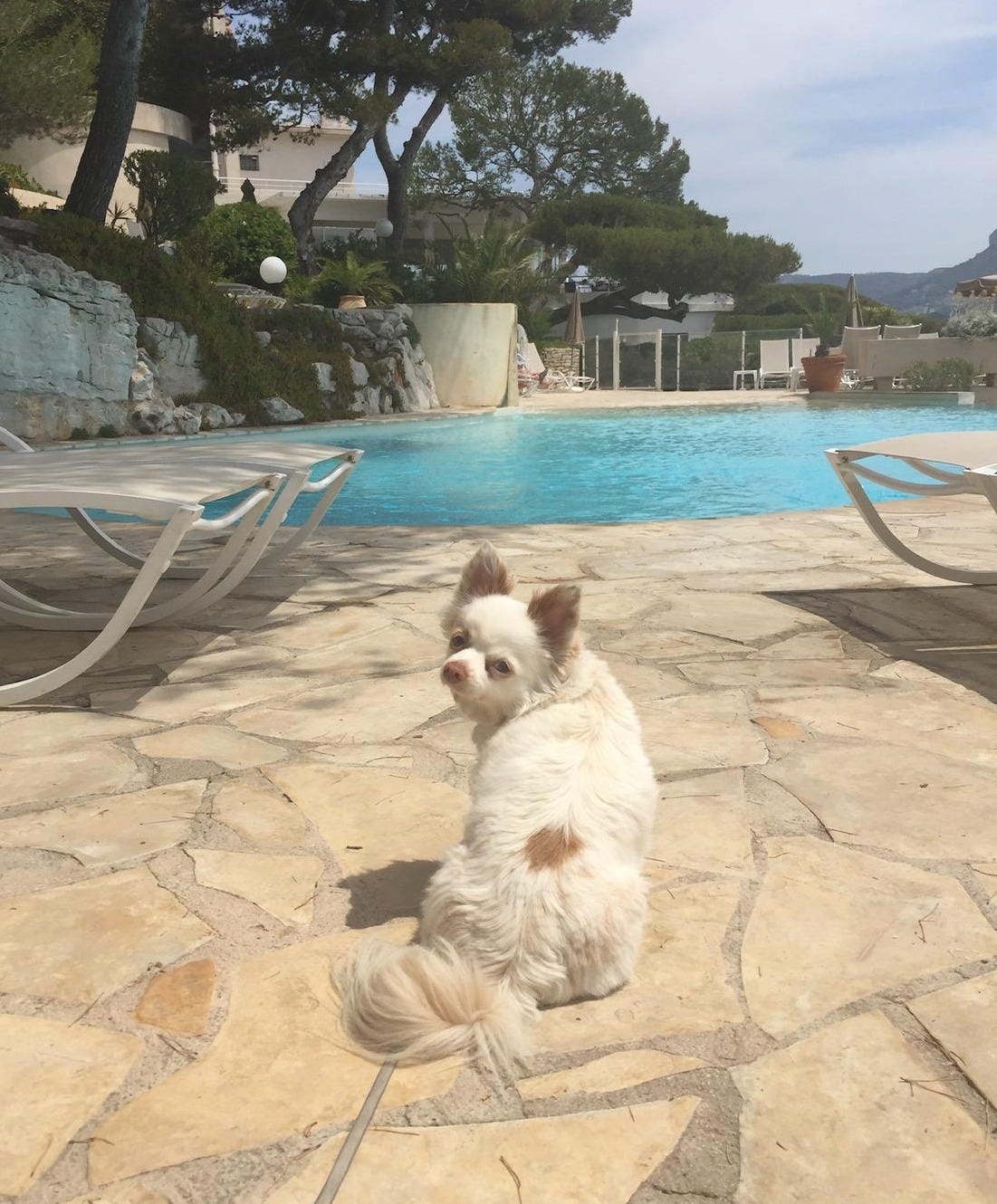
Chico, poolside in Provence.
The Sottaks are my kind of pet people. There was a lot of love in the Chico home, from all 4 of them. Their gentleness with and loyalty to the dog reflected the same manner they treat everyone in their orbit. Perhaps it’s why I feel blessed to remain in it. And also blessed to have been with them during this difficult week. Mike and Toni have been staying in Aix for the past month, and Chico picked this period start the hard slide. There are worse places to expire than Provence, eating well, drinking well, sitting poolside or on some attractive woman’s lap. Another Apero Spritz monsieur. Just going to relax here for the moment.
“Smells are the fallen angels of the senses.” Helen Keller
Then
US 50 runs the width of America, from Sacramento to Ocean City, Maryland. Every July my family would join this historic highway near Annapolis to make our summer sojourn to the sea. The towering Chesapeake Bay Bridge was a prominent midway point, and from there we’d pass south through Maryland’s Eastern Shore to Cambridge, and then due east. “One hour to Ocean City” my mom would say, and we’d all light up with the tingle of holiday anticipation.
What I remember most about these drives are the smells, in particular the briny aroma of the Atlantic Ocean that would tease us over those final 30 miles into OC. Our provenance was Central Pennsylvania farm country, with a July bouquet of shucked corn, cow manure, and farm machinery. I was a lucky child to have this upbringing, but eager to leave it behind for a week of waves and boardwalk adventure. On the long approach to OC we’d start passing a stream billboards advertising beachside hotels and restaurants (Philips Crab House: the Best Jimmies in OC!), the sky would assume a blue shimmering haze, and then the first waves of salty air would work through the vents of my dad’s 1960s blue Buick wagon. All thoughts of home, gone.
Now
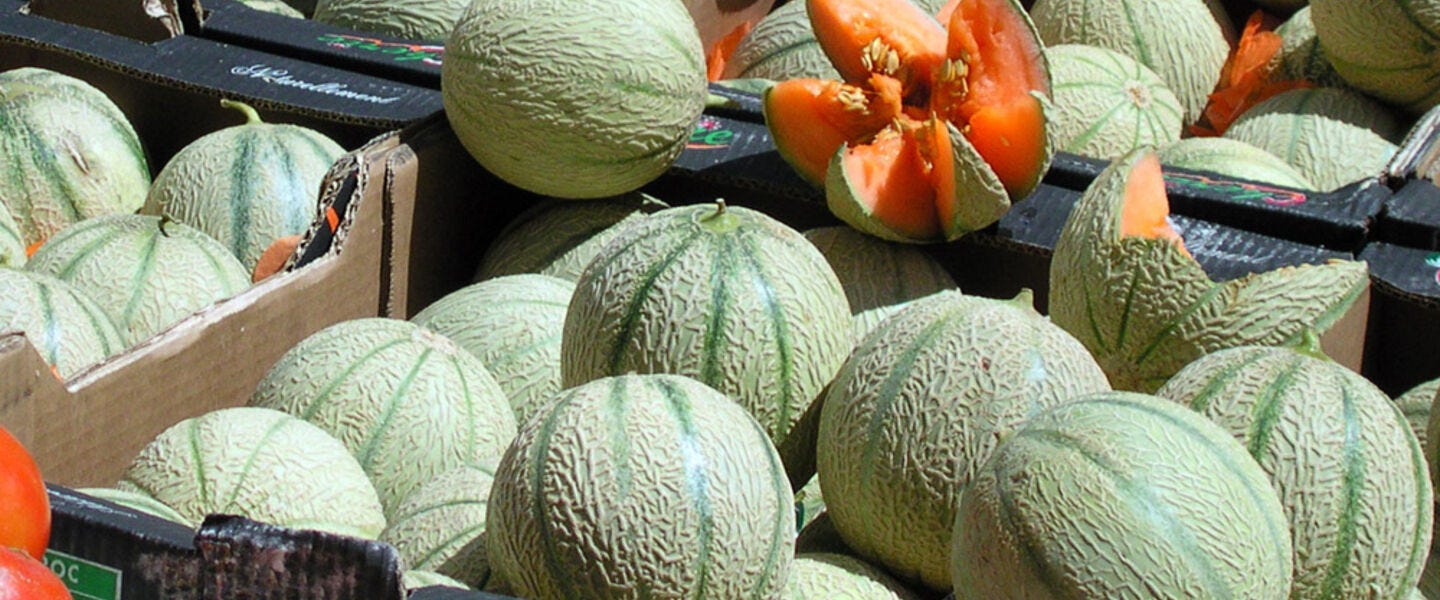
My days in Provence are also marked by a broad palette of smells, particularly rich through the summer months. The August stalls at the daily markets are full of ripe local peaches, apricots, and plums. It was strawberries in June and mountains of cherries in July. The figs and Cavaillon cantaloupes are so full of sugar now their skins crack and honeybees hover. Bunches of bright green mint sit among the fresh coriander and parsley at every stall, and lavender, harvested last month, is arranged in bouquets wrapped in twine or offered in small cloth sacks perfect for winter closets or dresser drawers. It can be sensorially overpowering.
Cavaillon melons at the local market.
This rich symphony of perfumes will fade in the fall, yielding to the more subtle scents of Mediterranean herbs – thyme, rosemary, bay leaves – and gourds halved or quartered for your Sunday soup. But it will be a fade, not a fold. I swear the blind can navigate Provence, at least the markets, on scent alone year around.
If I leave Provence someday it’s the smells that will most linger in memory. I don’t take them for granted, but I also don’t grant them enough significance in my calculus of happiness and place. The sight of lavender fields in June; the sound of cigale hordes (cicadas) in the hot summer countryside; the tang of local olives and chilled rosé at apéro hour, and the laughter of friends sharing said apéro; these things are unique to Provence and core to its charm. But it’s the fragrance of life here that I find most enchanting.
You
Are there scents that bring back your favorite memories? Are there smells uniquely symbolic to the region in which you live now? I ask you not to take these for granted. You may want to seek them out for a quick trip down memory lane. My dad (of the big blue Buick) lost his sense of smell around retirement age. He was not one to complain, but the enjoyment of my mom’s delicious casseroles was forever dimmed, as was his savoring of a ripe, juicy tomato picked from the family vine in July and sampled between the rows. Wow, that is a tomato! Now, go out and have a good sniff!
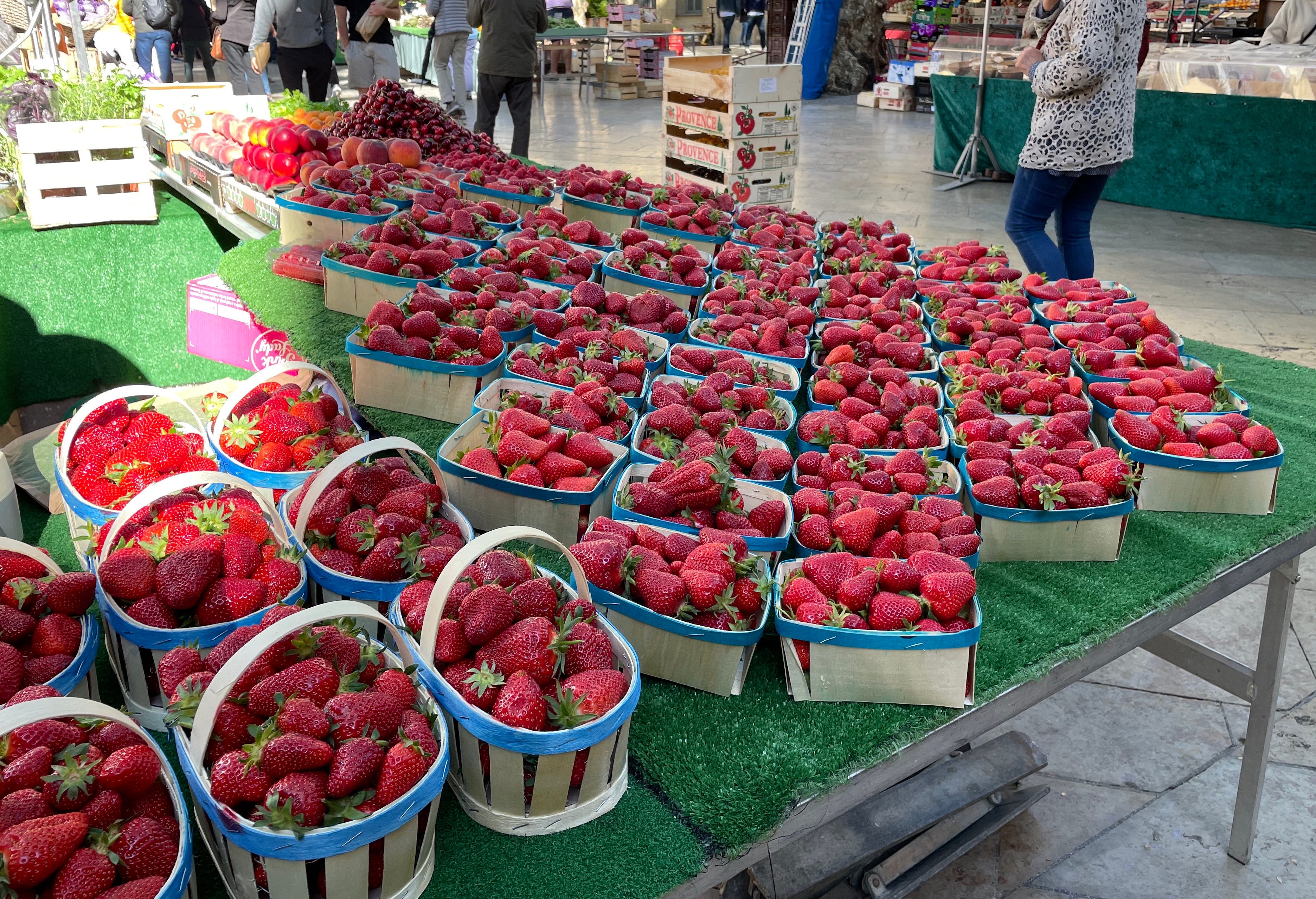
It’s springtime in Provence. The colors and smells of local markets have shifted notably with the sudden onset of warmer weather. Local strawberries, asparagus, and artichokes fill the market stalls with their vivid reds and greens. The sweet fragrance of the berries mixes with the earthy scent of fresh basil and mint, bunched in bouquets and piled in leafy mounds. The seductive mix tugs on my senses from a distance. So very unfair. Well now it’s impossible to leave without a purchase.
Strawberries at the Aix-en-Provence market, mid-May, 2023
I was at a friend’s home in the countryside last weekend. The fields by his cottage were flooded in bright red poppies, their delicate petals spread wide to the sun and swaying gently. Larks were whistling in a distant tree line. Wisteria blooms hung in heavy lavender clumps in his garden. His daughter called me over to give them a sniff. It was the peak of the day and we opened a bottle of chilled rosé, put out some Greek olives. Sensation overdose. Healthy hedonism.
The merits of indulgence
I love this time of year; that fresh spring dawn after a long winter night (which has its own merits. Read here.). Rebirth and new plans. Stimulation and inspiration and so many things to smell, taste, hear, see, and share. It fuels a deep sense of revival and limitlessness.
You may want to listen to these larks singing while you read on.
This indulgence of the senses, this spring sensuality is a great equalizer. Fresh-picked strawberries taste no better to the millionaire than the pauper. A hillside full of poppies looks no more stunning. One could argue that those with little appreciate these things more deeply than those with lots, but I won’t argue that. I have plenty of friends from both ends of that spectrum. It has less to do with wealth, more to do with a deep respect for those joys that only nature can conjure, that cannot be improved upon with more money. It brings us all together, to wonder at it all, and indulge.
Wade deeply into your senses, be seduced, swish them around like a good wine, close your eyes and become the sponge, savor, … life will feel richer and you may live longer. This is true actually, and backed up with empirical evidence. Research at Victoria University in New Zealand (by Erica Chadwick) and Harvard (by Jordi Quoidbach) identify the many benefits of savoring, including stronger relationships, improved emotional health, and enhanced creativity. All are known to favor more happy years above the dirt.
Fred Bryant, a social psychologist at Loyola University, has written extensively on this topic, including in his 2006 book Savoring: A New Model of Positive Experience. Bryant offers a variety of tips on training that savoring muscle. I condense it down to 3:
Awareness. Be acutely conscious of the moment you engage a sensation; something you smell or taste or hear or see. Go slow, ponder its effect, decipher. Luxuriate in the tingle (go on, you deserve it), immerse wholly, be the sponge.
Sharing. Share the moments and joys of sensory entanglement with others. Build bonds through the heady indulgence. There is no single factor more important to living longer, happier lives than close relationships. (Skeptical? Well Harvard say so! Click here.)
Gratitude. Simple indulgences shared with close friends are blessings. Respect your good fortune. Epicurus is surely smiling down at you. Embrace the pleasures and never take them for granted. Be humble, be grateful, and invite the happiness.
Protection from temptation
Of course there may be those who find this concept of sense and sensuality a bit too scandalous. Market strawberries dipped in Swiss chocolate, … and hand fed to me while in recline?! Abhorrent!
For those of you in this frightful camp, fear not, there is hope. The best prophylactic against incitement of the senses? That portable portal to all things digital, pixelated, and synthetic. It slips in your pocket and holds neatly in your hand. Never leave home without it. Your phone.
Arousal of the senses requires earthly engagement. Smelling things, tasting things, touching things, hearing things, and all of this done organically. It comes with a bit of dirt under the fingernails, a sunburn on the cheeks, your feet may get wet. For all the marvels of modern technology – and I have built a career around this stuff – it will never hack mother earth and the sensuality she offers.
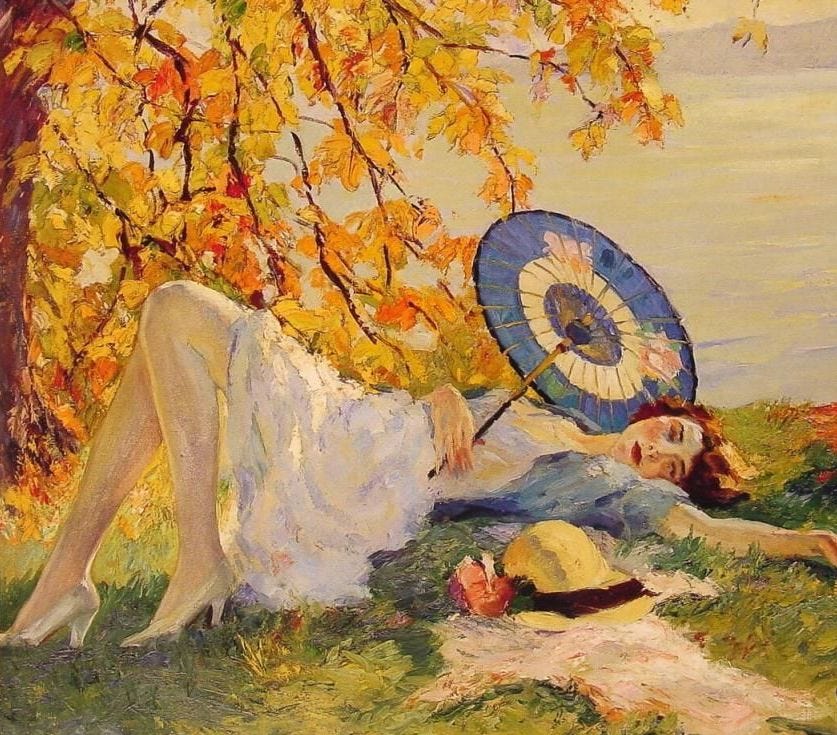
Edward Cucuel, Woman Reclining by a Lake
The phone is a perfect prophylactic against these primal, libidinous stimulations. For those who prefer digital approximation and virtual isolation to deep and dirty organic engagement. Why talk with the friend at your side when you can text to your friend at a distance. And when those 2 swap places you can text with the former sidekick. Missing you! ❤️ See, no need to actually engage in spontaneous, interactive dialog. We used to call that a conversation. Quant.
Strawberries? Plenty of photos online, and of flowers too. Just google it! You don’t even need to learn their names. I’m sure you can find an influencer or 2 in Provence with plenty of staged and artificially filtered photos. As far as the smell, taste, and touch of something organic and alive, … eww, that might require an antiseptic. Thank god for Apple.
Before I close, an open offer:
The outdoor markets in France are amazing in their variety, respect for all things local and seasonal, and great prices (no middle men!). The markets in Provence are the best in France, … well I’m biased. If you are passing through Aix-en-Provence and interested in a market crawl together get in touch. This is a pleasure for the senses that I love to share.
Suggested Song: I Thank You, Sam & Dave (See ZZ Top’s amazing live rendition, 2011) Suggested Drink: Your favorite herbal tea. (Pure joy on a cold night with a good book.)
Piglet noticed that even though he had a Very Small Heart, it could hold a rather large amount of Gratitude. – A.A. Milne
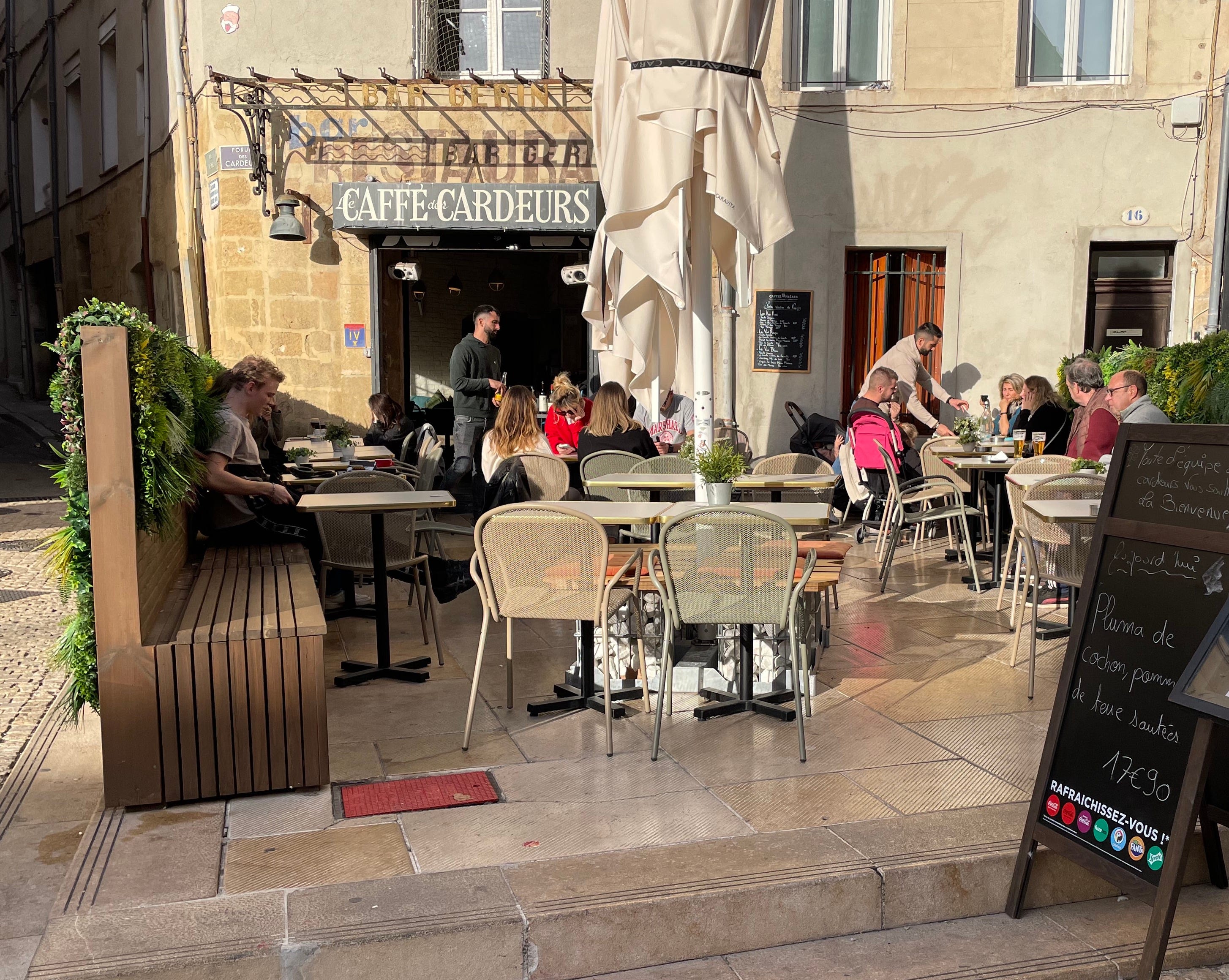
The Place des Cardeurs is the largest open plaza in Aix-en-Provence. A city block long and half as wide, the Cardeurs is ringed by restaurants and cafés and wine bars and beer pubs and gelaterias. It’s dining and drinking al fresco; open air in the summer, then under those large canvas and plastic tents the French have mastered through the years. Eat inside? But how would I smoke?
Weekend evenings in the Cardeurs are loud and collegiate, with throngs of students (there are over 30,000 in Aix) enjoying cheap drinks deep into the night. A chorus of laughs and chatter under strings of festive lights. Sundays awaken quiet and calm, with families and kids commandeering the massive terraced savannah, now void of the sea of tables and chairs from the evening’s bacchanalia. Off you go Junior, run that endless battery down while your mother and I enjoy a slow coffee.
It is to the Place des Cardeurs one comes for that Sunday afternoon glass late in the season. For, with its large expanse and low-slung periphery of buildings, the Cardeurs is the most promising spot in town to catch a few fleeting rays of hibernal sun. It seems to barely reach mid-sky during the Provence winters; a lazy ball that’s up late and done early. But it manages to arc just above the south-facing roofline through the afternoon, casting silhouettes of the tangle of unemployed antennas and vent pipes and chimneys.
Caffe Cardeurs, mid afternoon on the last Sunday of November, 2022
The Winter Mood
Darker, colder days like these can shroud a winter malaise over the cheeriest amongst us. I tend to stay buoyant but have family and good friends who can get gloomy, and I have seen what a demon that can be to wrestle. I follow a winter strategy to fend off despair: (1) lean into the season and (2) inoculate against melancholy with a regime of winter indulgences and rituals.
I lean in mostly with what I eat (lots of stews and soups), when I sleep (early), what I read (long tomes for long evenings), and whom I see (just a lucky few). As for rituals, I light the apartment with candles, spend money on bath salts, listen to Coltrane and Chet Baker while making dinner, and take an inside table at Lulu’s (click here for her menu of the week). These things I never do in the summer, except for the occasional Baker.
Rather than resisting the seasonal change, you might try embracing your winter hermit with arms wide. Retreat into your cave. Build your books-to-read stack. Re-up Netflix. Knit (kidding, consider any home craft). Nest. Bears do it. Squirrels do it. I do it. Try it. Spring will bring a sharper contrast in light, warmth, friends, and merriment. The buds and blooms will seem somehow more extraordinary, more appreciated. (For a fascinating rumination on hermitude and recluses read Michael Finkel’s A Stranger in the Woods: The Extraordinary Story of the Last True Hermit.)
Your Best Defense Against the Blues
The Thanksgiving holiday is a reminder that beyond the turkey and football (in both variations this fall), gratitude is a healthy addition to the winter regime. Giving thanks is the low-hanging fruit of happiness and effective at fending off the winter blues. If you need a positivity boost when the days are dark, expressing gratitude is the easiest and most impactful ritual you can adopt. Its power in building resistance to the dark side has been studied extensively.
Through his cutting-edge studies, Robert Emmons, professor of psychology at my alma mater UC Davis, has shown that gratitude “can lower blood pressure, improve immune function and facilitate more efficient sleep. Gratitude reduces lifetime risk for depression, anxiety and substance abuse disorders, and is a key resiliency factor in the prevention of suicide.” All can feel acute in the dark months. His findings match those by other thought leaders in the happiness field, such as Barbara Fredrickson (UNC Chapel Hill), Sonja Lyubomirsky (UC Riverside), and Martin Seligman (UPenn).
Gratitude journals, gratitude letters, gratitude circles; these are just a few of the options available to practice the practice, something we do in our Interprize workshops. You can find endless links to infinite articles online about this stuff. For more rigorous findings and suggestions, search on the names in the previous paragraph. What works best for me: a simple end-of-the-month inventory of people and things to which I am grateful. I keep it short – 5 or fewer – and don’t dwell on what or who misses the cut, … there is always next month.
If interested in the Bill Magill November gratitude list, I offer it here in no certain order. This past month I have been deeply grateful for:
1. My adventurous grandparents’ talent at staying alive (or I wouldn’t be typing this now). My maternal grandfather managed to survive the trench warfare of WW I as part of the Canadian forces fighting in France. About 67,000 of them didn’t make the return, another 4x that number were injured. Chances of making it home unscathed was less than 1 in 2. He was short and perhaps that helped keep the helmet low. Papa made it home.
My fraternal grandmother, just out of college, travelled south to teach at the Calhoun Colored School in deep Alabama in early 1900s. She was part of an alliance of northerners committed to the education of post-slavery children in a deeply segregated south. The Klan were no fans of such enlightened idealism. Educated white women elevating poor black kids; what was next, the vote?! As that wasn’t enough excitement, she later took a steamer from New York City to Alexandria, Egypt, alone, and then continued on to the Sudan where she married my Irish grandfather, traveling amongst the villagers and crocodiles and malaria. They made it back to the US in 1 piece, had a pack of kids including my dad, and in 1957 my tiny zygote squiggled into the world.
2. The brilliance of the classic novel “A Confederacy of Dunces. It kept a grin planted on my face through the entire month. Sadly, its author John Kennedy Toole ended his life in 1969, shortly after completing the novel. It took his loyal mother 11 years to find a publisher, but his genius and her perseverance were awarded with a Pulitzer posthumously in 1981. (Many thanks to Canadian Dave for lending me his dog-eared copy.)
3. My daughter’s impulsiveness. This call I got in October:
“Hey dad, I had a great tip week at work and was thinking of coming for a quick visit.” (From LA.) “Fantastic Stella, when?” “Uhhh, tomorrow?”
Melt.
Fortunately her mother works for United Airlines. You gotta love those standby perks.
4. The American voter and US court system for protecting that right. The large slate of kooky candidates running this fall on a platform of 2020 election denial – one has to admire this cult’s tenacious cling to disproven fantasy – was universally denied at the ballot box. And the courts, up to the Supremes, shot down the many attempts across numerous states at voter suppression. The people’s voices were heard and counted. Democracy triumphed. Whew!
5. The craftsmanship of my Martin guitar. I bought this D35 acoustic in 1989 new, an MBA graduation gift to myself (Bill, you are so amazing you deserve a reward!). With its lifetime guarantee I can walk into any certified Martin repair shop around the world and have it refretted, trued out, and tuned up for free. Its tone has only gotten warmer through the years and the body of spruce and Brazilian rosewood still looks beautiful. If curious to take a look see I made this tutorial video last week on how to play Little Bird. Even with the cheap recording acoustics of my tiny iPhone its sound quality is unmistakable.