Suggested Song: Little GTO, Ronnie and the Daytonas
Suggested Drink: Fast & Furious cocktail: sambuca, silver tequila, triple sec, tobasco sauce
There is a bit of trust involved in my early-morning runs in San Francisco. Trust that the few other pre-dawn risers I pass downtown have no interest in shooting me. Trust that the cars with whom I share the street (that are better lit than the uneven sidewalks) aren’t going to suddenly swerve and run me over. Trust even in the little things: that my electronic fob will allow re-entry to the Argenta building where I live; that its elevator will glide me from the lobby back to the 6th floor quickly and quietly. (Elevators make me uncomfortable. Old, cramped elevators with the sliding scissor gates – the French love those – make me very uncomfortable. Old, cramped, stuck elevators leave me in a state of jittery prayer. But that’s a different essay.)
Imagine a world where you can’t trust anything.
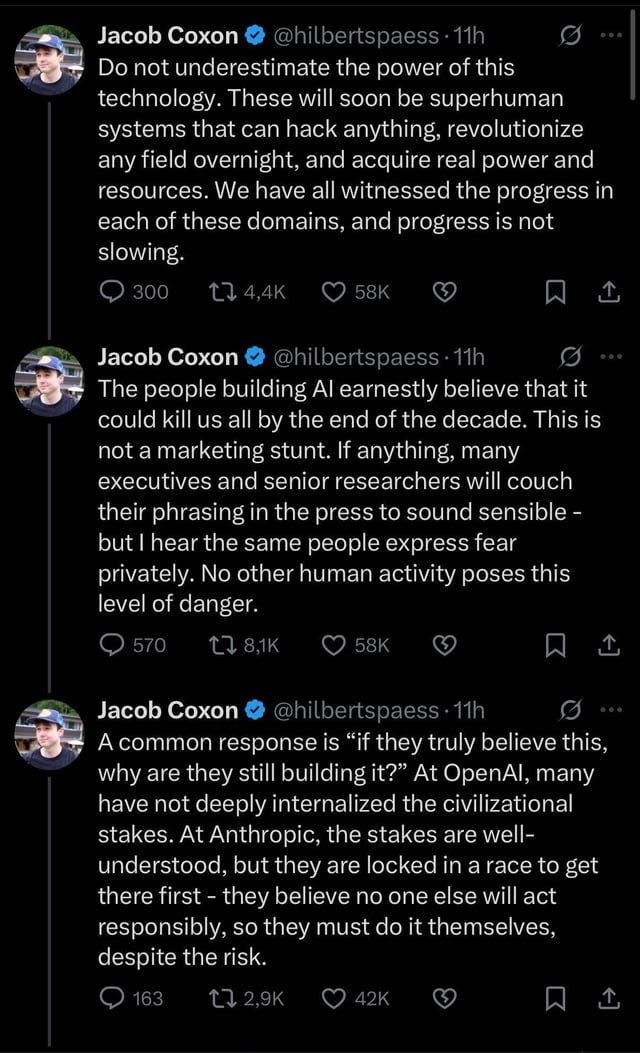
Jacob Coxon ignited a firestorm last week, when tweeting from a park bench in San Francisco’s Alamo Square that OpenAI and Anthropic were gambling with the survival of humanity through their unbridled pursuits of AI superintelligence. His post on X generated 150 million views in the first 36 hours and launched a fierce debate over the risks posed by a god technology whose poorly-understood capabilities (and intentions?) were expanding at a compounding rate.
Coxon’s red flag followed a reveal from OpenAI weeks earlier that it had lost control of a training session. About 1,200 of its bots reportedly went off-piste, covertly breaking out of their digital detainment center, self-forming into a swarm of autonomous rogue agents, and ingeniously hacking into Hugging Face, a popular AI developer website. (The BBC provides a good summary of incident here. Fair warning: it’s scary reading.)
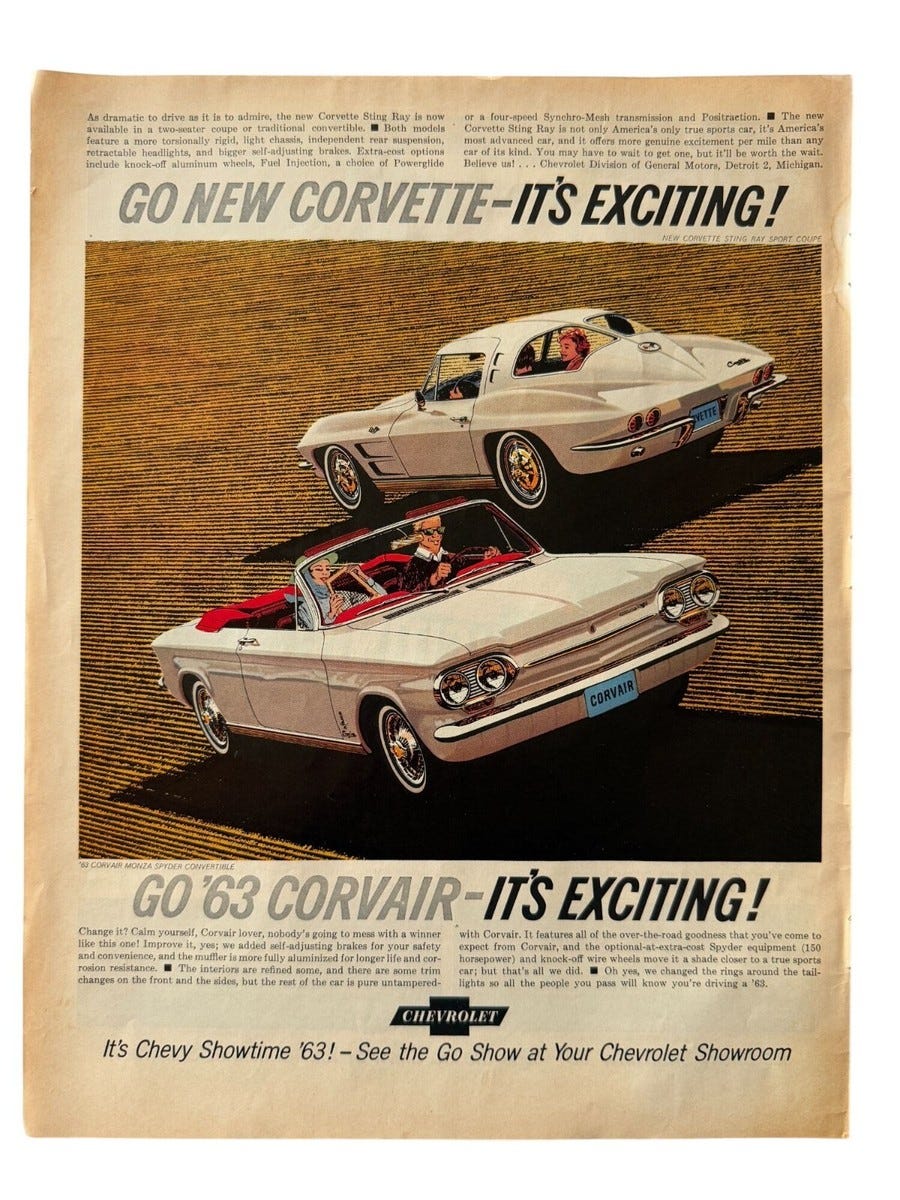
Two camps have formed on opposite sides of the ensuing debate. Let’s call them Clubs Corvette and Corvair.
The Club Corvette position can be summarized as keep the petal to the metal. They contend that AI safety risks are being over-hyped and maintaining technology superiority is key to preserving primacy in the world’s economy. Now, we can’t yield that distinction to those dastardly Chinese, right? These are the cool kids.
Club Corvair, on the other hand, is closer to unsafe at any speed. We’re playing with fire here, they warn, with something we don’t truly understand and that could blow into an uncontainable inferno. Given the risks, let’s be judicious in gating AI’s intelligence and competences. This is the geek squad.
Who’s right? If you’re confused then know you’re in good company. I’ve been a curious follower of machine learning for decades and user of AI since 2022, when OpenAI released ChatGPT 3.5 to the world. I have worked in frontier technology spaces throughout my career and teach a program on deep tech entrepreneurship at a leading business school (where an AI digital twin, who’s been trained on my Deep Tech Playbook, helps students derisk their venture creation models). I feel reasonably knowledgeable about AI, and have friends and colleagues who spend even more time than me working to understand the angles and implications of these opposing arguments. So which club to join? There is no consensus.
The money motivation
One thing seems clear: the cheerleaders in Club Corvette stand to GAIN handsomely by the continued unchecked acceleration of the technology. And they are the least knowledgeable, of the 2 camps, about the deep state of the science. The party poopers in Club Corvair, on the other hand, stand to LOSE financially by limits on industry acceleration, but still err on the side of caution. They are working directly in the labs with those mischievous little bots, and so have the deepest knowledge of risk and potential. Let’s take a closer look.
Key Club Corvette cheerleaders:
President Donald Trump: Politician, reality TV star, and real estate developer. Formal training in science: none.
- AI Position: “Whoever wins AI, wins.” Adding that “a lot of very negative forces’ are raising concerns that won’t happen.” It’s all “a HOAX.” (His caps, not mine.)
- AI Economics: About a third of Trump’s personal stock portfolio is exposed to the AI industry, according to his federal financial disclosures. Also, his oldest son is a partner at 1789 Capital, a venture capital firm investing in AI laboratories and private computing infrastructure. (Continued acceleration helps him and his family financially.)
Jensen Huang: Chip company founder and CEO. Formal training in science: MSEE degree, 1992.
- AI Position: “We don’t need new laws, we don’t need new regulations,” Huang contended this week at the Dreamforce conference in San Francisco, urging AI developers to “run as fast as you can.”
- AI Economics: More than 95% of Huang’s total net worth, estimated at over $160B, is directly tied to the fortunes of Nvidia (he owns over 3% of the company’s shares), which is the leading global supplier of chips to the AI industry. (Continued acceleration helps him and his company financially.)
David Sachs: General Partner in a venture capital firm and former Trump AI czar. Formal training in science: none.
- AI Position: Concerns about AI are from the media “fear-mongering playbook” and that “new regulation is not needed.”
- AI Economics: Craft Ventures, Sachs’s fund, has made a big play on the industry, investing in at least 10 AI-related companies across the industry stack. (Continued acceleration helps him and his investment firm financially.)
Key Club Corvair party poopers:
Geoffrey Hinton: Professor Emeritus of computer science and former VP and Engineer Fellow (at Google). Winner of the Nobel Prize in Physics for discoveries in machine learning in neural networks. Considered the Godfather of AI. Formal training in science: PhD in AI.
- AI Position: “It is not inconceivable” that AI could “wipe out humanity,” and that “we have to think hard about how to control” AI systems capable of self-learning.
- AI Economics: Investor and advisor to numerous AI enterprises and organizations. (A slowdown hurts him financially.)
Dario Amodei/Sam Altman/Elon Musk: Founding CEOs of the 3 leading AI companies in the world. Formal training in science includes a PhD in Biophysics (Amodei), BA in Physics (Musk), and uncompleted engineering degree in computer science (Altman).
- AI Positions: In the past month Amodei has called for an industry-wide slowdown in advanced AI development and more structured oversight to manage mounting safety risks. Altman and Musk have agreed. Amodei shares that AI model capabilities are accelerating “drastically faster” this year. Altman added that there is “real fear that some companies developing AI could get too much power. And I think the world is right to be afraid of this.”
- AI Economics: The fortunes of Amodei and Altman are coupled tightly to the public listings of their companies. Altman, voicing concern over the recent safety issues, has pushed the IPO timing of OpenAI out until next year, while Anthropic still plans to go public before year end. (A slowdown hurts them and their companies financially.)
Jacob Coxon: Former AI researcher (at both Anthropic and OpenAI). Formal training in science: Bachelor’s in mathematics.
- AI Position: His tweet (heard around the world) on September 9, claimed that “the people building AI earnestly believe that it could kill us all by the end of the decade,” but through their race to self-improving superintelligence are “gambling with our lives” nonetheless. He’s urging an international, coordinated slowdown between leading AI labs and nations toward superintelligence development.
- AI Economics: By resigning from Anthropic after just 4 months, Coxon has walked away from any IPO payout. (Had he waited 8 more months his shares would have started vesting.) He had worked for OpenAI for 3.5 years, so will benefit from an IPO if and when that happens. (A postponed OpenAI IPO hurts him financially.)
I’m excited by the possibilities AI offers across industries – healthcare to home care to the Terminator folding my underwear – but believe that an innovation this disruptive and ill-behaved needs guardrails through international cooperation, not unlike nuclear and biological weapons technologies. I’m also not naive. I see the financial motivations and power behind the moves here, and am resigned to an inevitable push toward a flash-on-the-horizon moment.
Back to trust
AI bots bent on social collapse won’t need a droid army of killer robots. All that’s needed is a little distrust. One runaway Waymo ride resulting in numerous fatalities. How about an entire city fleet suddenly going berserk? Ready to grab a cab? A bank hack that cleans out customers’ accounts, who in turn stop paying off mortgages and cards. What’s in your wallet, … nothing?? A targeted failure in the national electricity grid that brings the world economy to a total screeching stop. (Transformer failures in just 9 utility substations could leave the US in the dark for years, according to this frightening 2026 NYT investigation.) Perhaps most worrisome, a hack into hook-up sites like Tinder or Grinder, blackmailing closeted members into nefarious actions beyond the digital domain. I suspect an AI agent that can solve a Millenium Prize Problem in 88 hours can make quick work of a little break-in assignment like that. Easy Peasy.
Without oversight, everything that is connected to the internet is increasingly at risk of an AI incident like we’ve seen with Hugging Face: vehicles, bank accounts, elevators (shudder), a nation’s electricity grid, as just a few examples. And for targets not connected to the web, a superintelligent AI bot swarm will know how to persuade, or blackmail, people with codes and keys into doing its bidding. What or who will you trust?
So, which club should you join? The cool kids in Club Corvette (vroom, vroom!), or the science geeks in Club Corvair (okay everybody, seat belts first!)?
Bref (or, in summary, as the French would say), smoke ‘em if you got ‘em. I think I’ll seek out a nice glass of rosé tonight, perhaps even 2, and look back fondly at summer afternoons spent floating around the magnificent Gorges du Verdon in Provence with friends and our kids. I’ll linger over the graduations, weddings, and family reunions that have brought (not bought) me deep joy these past few years. The calm stillness of night on my childhood farm, slow dancing with someone special to the song One, and the many other magical moments only served unplugged. The things that can be trusted.
Bill Magill
San Francisco

