Suggested Song: Tradition, from Fiddler on the Roof. Suggested Drink: Mint tea: green tea, fresh mint leaves, sugar. Moroccan tradition calls for it to be served 3 times: “The first glass is as gentle as life, the second is as strong as love, the third is as bitter as death.”
Listen to this Postcard.
I enjoy religious traditions for the food with friends. Honey-dipped apples on Rosh Hashanah, a lamb tajine to break Ramadan, Christmas dinner followed by the equally revered American football. Spirituality is found in a savory meal shared with people you love and most appreciate. The real magic is bubbling in the kitchen, those moms (and occasional dads) doubled over a pot or pan, or sliding some massive bird out of the oven. For me these are the true healers and most divine.
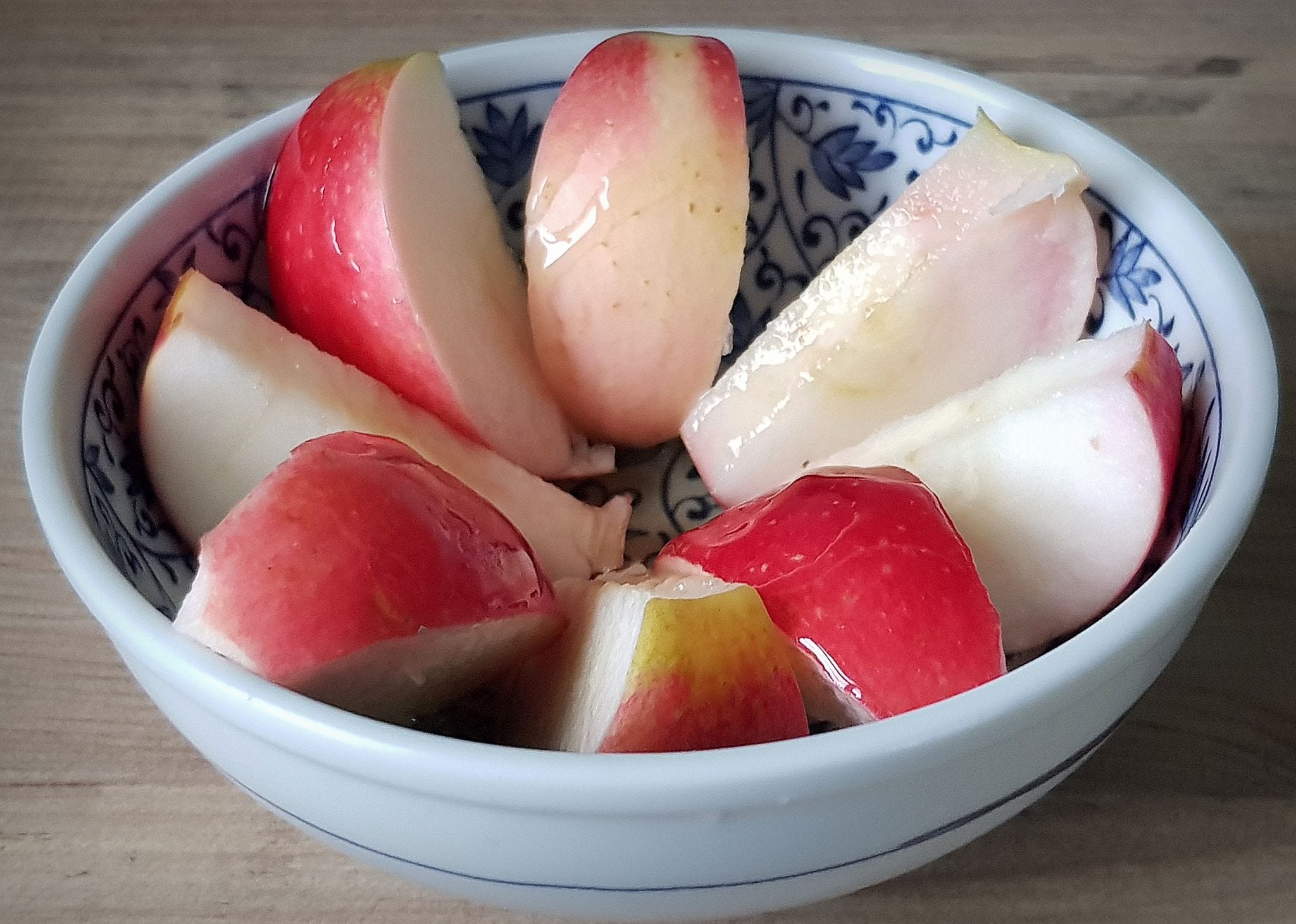
Apples coated in honey (yumm!).
Sacred holidays encourage observers to consider their blessings for the past year (as opposed to New Year’s Eve, which is all about resolutions for the one ahead). They also challenge us to contemplate death; to be grateful that Mr. Grim again missed our doorstep, but consider those obligations to which we aspire should our luck run out before the next celebration.
This is not a morose exercise. Quite the contrary, it’s a provocation to leap forward by looking back, to get our houses in order and ambitions pursued.
Why did I matter? How will I be remembered? Whom had I served?
Was the past year helpful in answering these questions? Most importantly, dear reader, when you sit at this same table of celebration next year (should Mr. Grim again miss your door) will you be closer to answering these questions?
I have a fascination with this theme and written more than a few Postcards about the merits of embracing our mortality – okay, perhaps accepting is a more comfortable word – and doing something about it, … now. With sunny titles like The Dead and the Dying and Prepare to Die I’m starting feel like Mr. Grim myself. But Rosh Hoshanah, starting today, offers another kitchen tradition for us all – from Jews to heretics like myself – to gather at the table, share in our good fortunes, and imagine what we’ll talk about at the next annual gathering.
On a more reverent note, today also marks the 1 year anniversary of the death of Mahsa Amini, brutally murdered by the morality police in Tehran for the sin of not having her hair properly covered in public. She was a country girl with big dreams. College and law school and who knows what more. She had just stepped off the bus that sunny morning in Tehran. I imagine her small-town wonder at this big bustling city and all of its possibilities, the cafes and bazaars and city sounds and people, … the buzz and energy. This was taken from her, and her gift was taken from us.
Mahsa Amini (2000-2022)
We cannot forget Mahsa, or Jina as she was known to her Kurdish family. We must keep that candle burning bright as a torch, not only to her but all the women in this world suffering from the oppression of righteous men who know just how to keep them in their goddam place.
Like most of us I was deeply shaken by this unjust tragedy, and I wrote a song for Mahsa the next day called Little Bird (click here to listen).
Suggested Song: Respect Yourself, The Staple Singers Suggested Drink: Bud Light. A power brand making a righteous stand. Bravo!
A rock pile ceases to be a rock pile the moment a single man contemplates it, bearing within him the image of a cathedral. – Antoine de Saint-Exupery
This is #6 of 12 experiments for the year, offered to get you inspired, thinking creatively, and organized in the pursuit of bold life ambitions of deep personal meaning. This mid-point experiment focuses on your brand; aka, that perceived image the world holds of you. I don’t need a brand! you say. Inside tip: you have one. Rock pile or cathedral. It’s not a question of creating your brand, it’s the importance of managing it. Onward!
Brand Management
IF you’re at midlife and considering an exciting encore career, committed to pursuing a grand (dare we say audacious!) ambition of deep personal meaning for your second act,
THEN you need a keiretsu of supporters, partners, and (possibly) paying customers THAT need to be persuaded of your dream’s merits, WHICH mean selling yourself as well as the dream.
This requires a compelling brand.
You may think you’re just writing a book. First, you’re selling the image of an exceptionally talented, uniquely insightful master of words and storytelling. Underwood on the table, disheveled bookshelf behind, contemplative stare. If not, why would anyone besides mom support your effort or buy your book? (Over 3.5 million books are published annually in the US alone; plenty of options.)
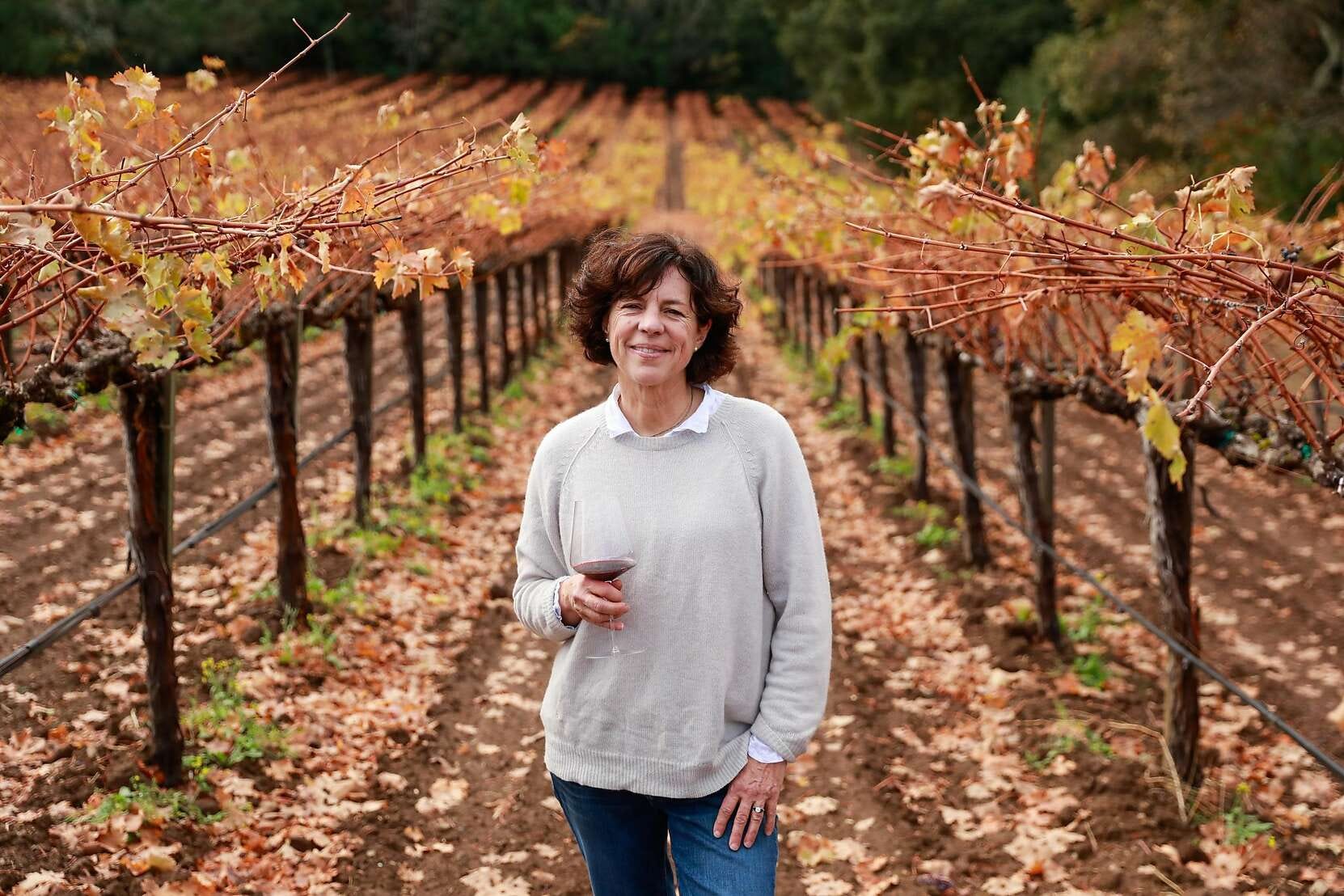
Francoise Peschon of Vine Hill Ranch, Napa Valley
You may think you’re just reviving an old, neglected winery. First, you’re selling the image of a passionate oenophile who loves tending the vines and is committed to relaunching a label with respect to the quality and history of that abandoned, storied vineyard. Tattered straw hat on head, glass of red in hand, big smile. If not, why would anyone besides mom support your effort or buy your wine? (Over 11,000 wineries bottle the grape in the US alone; plenty of options.)
You may be pursuing a dream that is completely noncommercial. Going back to school to earn an MFA in English Literature. Organizing a group climb of Mount Kilimanjaro, perhaps to raise money for Cystic Fibrosis, or maybe just because it’s there. In these and other towering ambitions you’ll be engaging with others – your patrons – and they’ll decide on the time and energy level you warrant. Warrant a lot. It will build your confidence and boost your chances of getting up that mountain. Nothing gets achieved alone.
All companies big and small work hard on their brand. Most startup founders do as well. Elizabeth Holmes, of the late Theranos scandal, branded herself as the next Steve Jobs and raised $945 million on the turtleneck ruse. (The rebranded Liz Holmes started her stint at a federal prison facility in Texas this week, sans turtleneck.) Entrepreneurs need a brand. Interpreneurs likewise need a brand.
4 Steps to Finding and Framing Your Brand
Customers don’t buy what you do, they buy why you do it. – Simon Sinek (Click here for his insightful video on WHY versus WHAT.)
There is an infinite selection of articles on brand creation and management at the click of a Google search, offering 5 or 7 or 10 steps to brand nirvana. I’ve read a few, talked with my friend Noel Thevenet, an expert in the field of tech branding, and even asked my 2 AI PAs: ChatGPT and Pi. Common threads weave through all of this advice, starting with WHY you do what you do, not WHAT.
This takes us back to our first 2 experiments of the year, The Wheel of Life and My Eulogy, which are all about finding your WHY (pursue a grand ambition of deep personal meaning). Your brand must emote from the WHY, then be reflected in the WHAT.
With that in mind, here are 4 solid steps to launch a search for your brand:
1. List what you stand for as reflected in the key values, passions, strengths, and other qualities that collectively power that pursuit of your grand (dare we say audacious!) ambition.
2. Develop a concise message that best captures these qualities. Does it reveal both what you offer and the core values of your interprize? Does the brand statement reflect benefits to your patrons; those people reading your book, drinking your wine, or joining you up on that mountain?
3. Is the brand in harmony with the Mission Statement you created in Experiment 3: Your Mission Definition? Together they should align with the North Star guiding everything your Interprize stands for: fulfilling your purpose, serving your patrons, impacting your community, and being a positive force in the world.
4. Does the brand feel honest to the authentic you? Presenting yourself as a bookish writer or wine-stained vintner might feel right to the role, but will kill your credibility in the long run if proven to be disingenuous. Just ask Liz.
As with earlier experiments, I encourage you to step away from your brand statement for a few hours, then take a fresh look. The next morning reread it as well. With each review you may tweak this or that to strengthen the identity. You may decide to restart from the beginning. Paint yourself and your ambition in a beautiful, authentic light that draws people in. Play with it. Enjoy it. Don’t rush it.
Other Considerations
Crafting your brand identity through a well-honed statement is just Step 1 in brand creation. Communicating it through logos, colors, music, and a web presence that together creates an emotional connection with your patrons is essential. So is revealing it to your network and constantly checking for consistency. Again, there are plenty of free online resources for this: podcasts, articles, edX courses, and other.
When I launched the Interprize Group in 2013 I hired a professional designer to collaborate on my logo. My WHY? I was passing through a phase of intense personal reinvention, having just moved to Provence from San Francisco, and wanted to leverage what I was learning (through soooo many mistakes) to encourage and enable others in their pursuits of bold ambitions of deep personal meaning.
Tarik had a few proposals and we ultimately settled on the color green (for abundance and rebirth), a custom font (to reflect playfulness but competency), and a circle surrounded by inward facing tips (to impart community and openness). Money wisely invested, and the infinitely talented Tarik Koivisto remains a good friend to this day. (Her own professional reinvention – Luxe Provence – is branded as a slow fashion and lifestyle brand celebrating effortless chic. Check it out.
If you want to know more about the art of interpreneurship or our upcoming Life Leap workshops, you can contact me through the site here or at bill@interprizegroup.com.
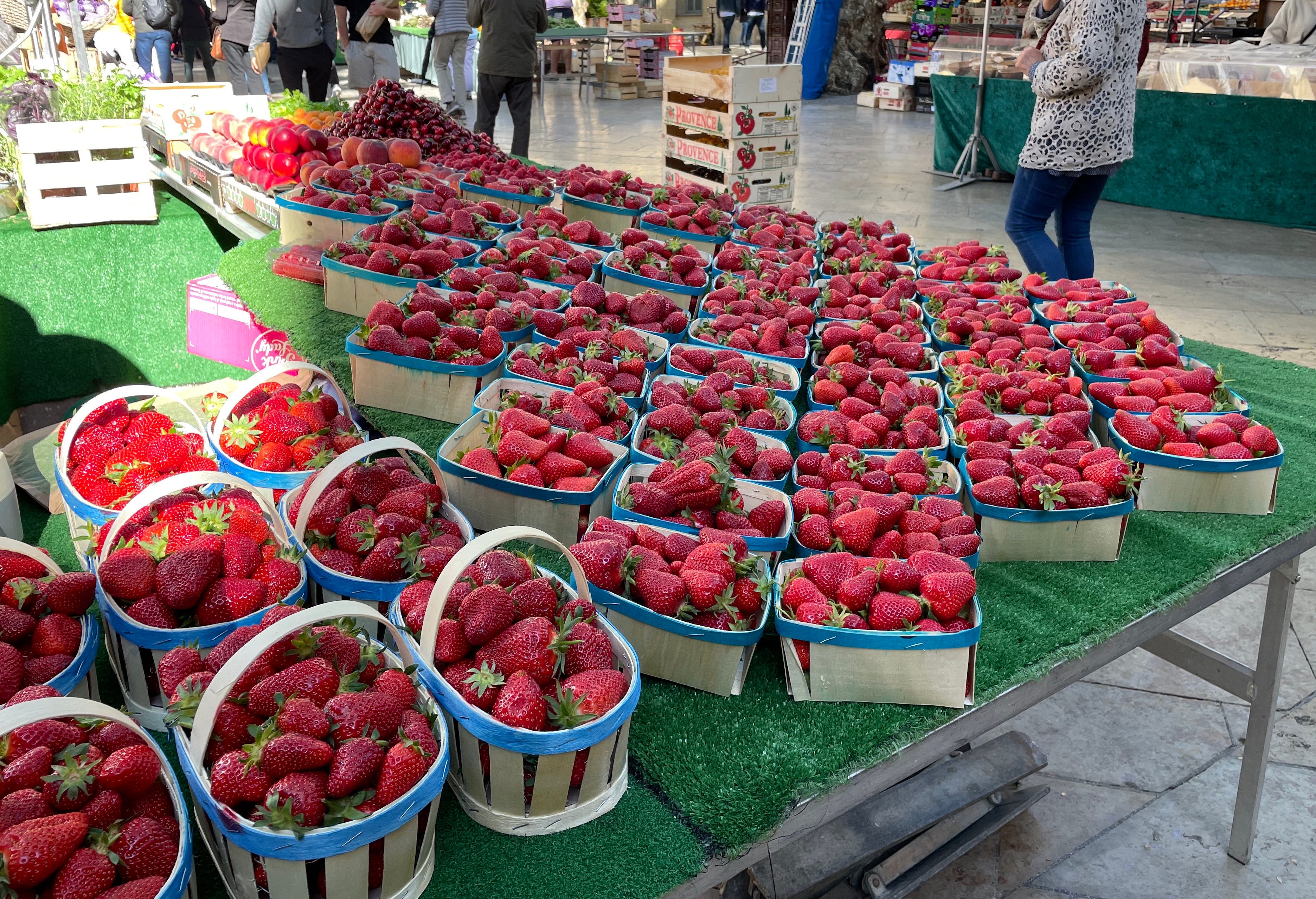
It’s springtime in Provence. The colors and smells of local markets have shifted notably with the sudden onset of warmer weather. Local strawberries, asparagus, and artichokes fill the market stalls with their vivid reds and greens. The sweet fragrance of the berries mixes with the earthy scent of fresh basil and mint, bunched in bouquets and piled in leafy mounds. The seductive mix tugs on my senses from a distance. So very unfair. Well now it’s impossible to leave without a purchase.
Strawberries at the Aix-en-Provence market, mid-May, 2023
I was at a friend’s home in the countryside last weekend. The fields by his cottage were flooded in bright red poppies, their delicate petals spread wide to the sun and swaying gently. Larks were whistling in a distant tree line. Wisteria blooms hung in heavy lavender clumps in his garden. His daughter called me over to give them a sniff. It was the peak of the day and we opened a bottle of chilled rosé, put out some Greek olives. Sensation overdose. Healthy hedonism.
The merits of indulgence
I love this time of year; that fresh spring dawn after a long winter night (which has its own merits. Read here.). Rebirth and new plans. Stimulation and inspiration and so many things to smell, taste, hear, see, and share. It fuels a deep sense of revival and limitlessness.
You may want to listen to these larks singing while you read on.
This indulgence of the senses, this spring sensuality is a great equalizer. Fresh-picked strawberries taste no better to the millionaire than the pauper. A hillside full of poppies looks no more stunning. One could argue that those with little appreciate these things more deeply than those with lots, but I won’t argue that. I have plenty of friends from both ends of that spectrum. It has less to do with wealth, more to do with a deep respect for those joys that only nature can conjure, that cannot be improved upon with more money. It brings us all together, to wonder at it all, and indulge.
Wade deeply into your senses, be seduced, swish them around like a good wine, close your eyes and become the sponge, savor, … life will feel richer and you may live longer. This is true actually, and backed up with empirical evidence. Research at Victoria University in New Zealand (by Erica Chadwick) and Harvard (by Jordi Quoidbach) identify the many benefits of savoring, including stronger relationships, improved emotional health, and enhanced creativity. All are known to favor more happy years above the dirt.
Fred Bryant, a social psychologist at Loyola University, has written extensively on this topic, including in his 2006 book Savoring: A New Model of Positive Experience. Bryant offers a variety of tips on training that savoring muscle. I condense it down to 3:
Awareness. Be acutely conscious of the moment you engage a sensation; something you smell or taste or hear or see. Go slow, ponder its effect, decipher. Luxuriate in the tingle (go on, you deserve it), immerse wholly, be the sponge.
Sharing. Share the moments and joys of sensory entanglement with others. Build bonds through the heady indulgence. There is no single factor more important to living longer, happier lives than close relationships. (Skeptical? Well Harvard say so! Click here.)
Gratitude. Simple indulgences shared with close friends are blessings. Respect your good fortune. Epicurus is surely smiling down at you. Embrace the pleasures and never take them for granted. Be humble, be grateful, and invite the happiness.
Protection from temptation
Of course there may be those who find this concept of sense and sensuality a bit too scandalous. Market strawberries dipped in Swiss chocolate, … and hand fed to me while in recline?! Abhorrent!
For those of you in this frightful camp, fear not, there is hope. The best prophylactic against incitement of the senses? That portable portal to all things digital, pixelated, and synthetic. It slips in your pocket and holds neatly in your hand. Never leave home without it. Your phone.
Arousal of the senses requires earthly engagement. Smelling things, tasting things, touching things, hearing things, and all of this done organically. It comes with a bit of dirt under the fingernails, a sunburn on the cheeks, your feet may get wet. For all the marvels of modern technology – and I have built a career around this stuff – it will never hack mother earth and the sensuality she offers.
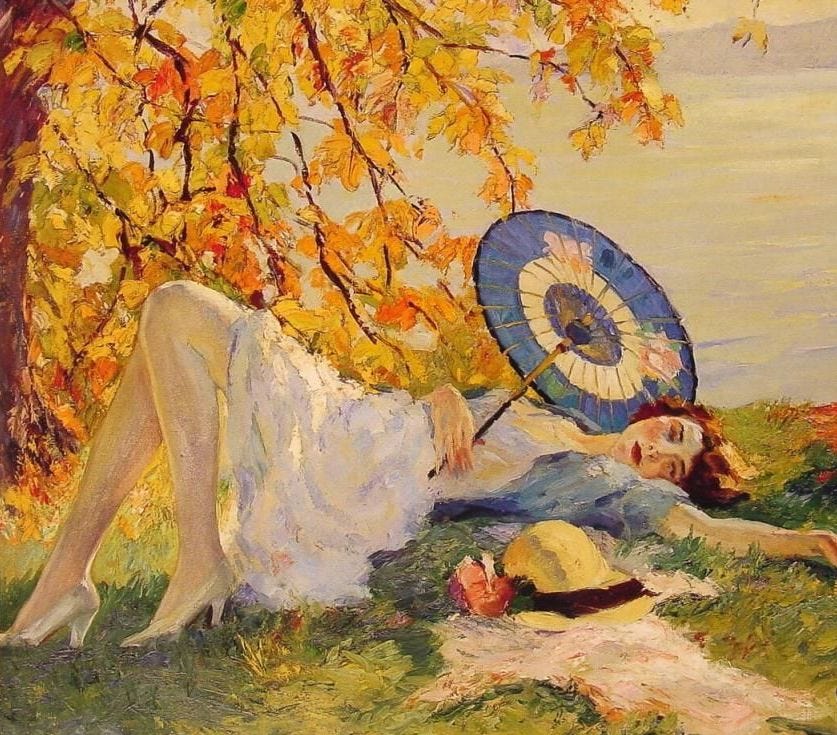
Edward Cucuel, Woman Reclining by a Lake
The phone is a perfect prophylactic against these primal, libidinous stimulations. For those who prefer digital approximation and virtual isolation to deep and dirty organic engagement. Why talk with the friend at your side when you can text to your friend at a distance. And when those 2 swap places you can text with the former sidekick. Missing you! ❤️ See, no need to actually engage in spontaneous, interactive dialog. We used to call that a conversation. Quant.
Strawberries? Plenty of photos online, and of flowers too. Just google it! You don’t even need to learn their names. I’m sure you can find an influencer or 2 in Provence with plenty of staged and artificially filtered photos. As far as the smell, taste, and touch of something organic and alive, … eww, that might require an antiseptic. Thank god for Apple.
Before I close, an open offer:
The outdoor markets in France are amazing in their variety, respect for all things local and seasonal, and great prices (no middle men!). The markets in Provence are the best in France, … well I’m biased. If you are passing through Aix-en-Provence and interested in a market crawl together get in touch. This is a pleasure for the senses that I love to share.
This is #5 of 12 monthly experiments for the year, offered to get you inspired, thinking creatively, and organized in the pursuit of bold life ambitions of deep personal meaning. For this fifth experiment in the art of interpreneurship I again borrow heavily from my work in entrepreneurship. Not clear on the difference? Click here.
Customer empathy is a core pillar of business model creation and taught in business schools worldwide, including in my startup courses for INSEAD and the American College of the Mediterranean (ACM), here in Aix-en-Provence. A book I’m cowriting at the moment on deep tech commercialization has a chapter committed to it, with this passage at the start:
Capturing customer empathy has risen to the apex of critical deliverables in most workshops, courses, and publications on business model development. It resides at the core of lean-inspired startup methodologies, and for good reason. Before precious time and significant sums of capital are invested (and likely wasted) in product development it is essential to understand the customers’ needs, pains, limitations, and other factors that help you maximize value through product design and a go-to-market strategy.
The pursuit of a grand personal ambition – your interprize – also requires the mastery of customer empathy to maximize commercial success. But there is a distinct beauty to interpreneurial endeavors: the primary metrics of success are not measured in units shipped or profits made, but rather in passions fed and purpose found.
That sounds seductive (and poetically penned!). Let’s take a deeper dive.
On Customer Empathy
Empathy:the action of understanding, being aware of, being sensitive to, and vicariously experiencing the feelings, thoughts, and experience of another. Merriam-Webster Dictionary
Entrepreneurs are an excitable lot. They experience a business epiphany or make a science discovery and the eyes go Davey Jones sparkly. Bank accounts are drained, months are consumed, and deep in the dark bowels of a lab or living room a shiny new widget is perfected. Then off to the market they charge with a world-beating solution and heart full of hope, … and inevitable disappointment.
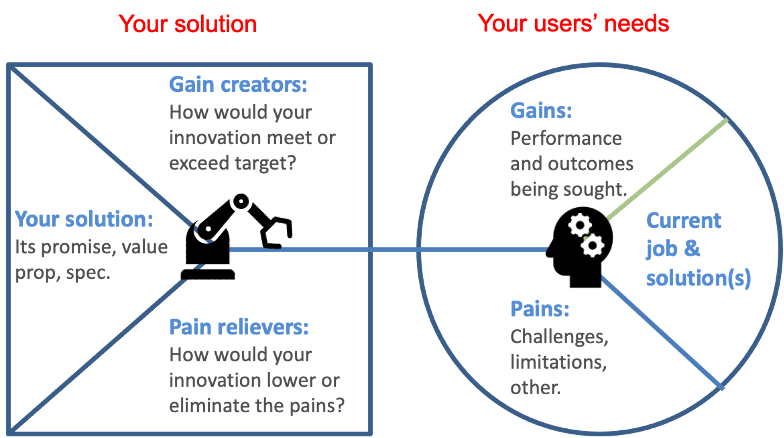
Entrepreneurship 101 now leads us with market need, not product design. Okay, you have a promising concept. Now, who is the target customer; what work are they doing; how can your concept bring gains to their undertaking of that work; how can your concept reduce pains in their undertaking of that work? Customer empathy is MBA-speak for the process of working through these questions and gaining a deeper sympathy for your customer and their job BEFORE focusing on product perfection.
An illustration of the customer empathy process looks like this:
Source: Strategyzer, The Value Proposition Canvas (adapted by the Interprize Group)
On Customer Compassion
Compassion: a sympathetic consciousness of others’ distress together with a desire to alleviate it. Marriam-Webster Dictionary
Compassion goes one step further than empathy. It requires action. Being deeply empathetic to the customer experience is a critical Step 1. Figuring out how to apply that understanding to optimize customer happiness is the compassionate Step 2. This is achieved through effective product/service design, delivery, support, and other business model elements that amplify user gains and reduce user pains.
As a new shiny gadget’s features and support align with the customers’ wants and needs we arrive at product-market fit (yet more business school speak). It’s a guiding principle to product design that requires constant validation and tweaks.
The Interprize Exception
Interpreneurs and entrepreneurs have a lot in common, particularly the desire to create something of great value and share it with the world. But we interpreneurs enjoy one crucial exception: the pilot customer is facing us in the mirror. Our fundamental motivation for the early mornings and late nights and hard-earned savings spent is in the search for purpose that is found through this sharing.
That search takes precedence over the market competitiveness and profit optimization of our shiny new gadget. And this liberating distinction gives us great license to create in our own image, to nourish our deepest passions, possibly and acceptably to the detriment of success as measured in conventional business terms. We call this hybrid principle product-passion fit. (That term is very much NOT business school speak.)
Examples may be helpful.
Marcia is a classic interpreneur. Her core career was spent mostly in marketing and sales in Silicon Valley’s tech world of venture-backed, high-flying startups. Living for the moment in Provence, she is an artist of impressive talent, and the sharing of this gift guides her encore career.
Marcia just completed my course on startup entrepreneurship at the ACM, working through 10 weeks of Bill Magill on mission statements and elevator pitches and product-market fits and business model canvases and fundraising, … and yes, also on customer empathy.
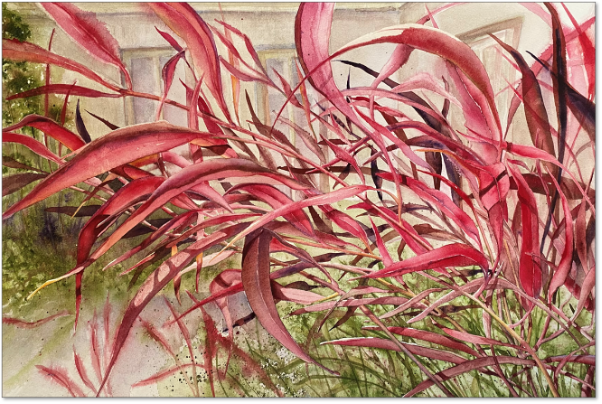
Jeux d’Ombres, Marcia Mason Speece
She was a great student and this grounding in basic entrepreneurship should enable even greater success with the spread and sales of her art. That is important, not only in helping pay the bills but validating her gift with the buying public. But Marcia will paint her garden watercolors irrespective of market success. It is her interprize, that prize within. It’s something she cannot not do. It defines who she is. It is her passion and through the sharing of this gift she finds purpose. Validation IS appreciated. Validation IS NOT the paramount objective. With her encore career she’s seeking product-passion fit.
My interprize is to write and stage rock dramas. I could plow ahead with a script and music and charge off to Broadway in search of open arms. Or, before setting pen to paper and fingers to keys, I could make an effort to understanding the arts of musical development and script writing, my specific audience (young, old, rockers, opera goers, theatre regulars, theatre newbies), what they want in a story (old stories reimagined, new stories freshly written), where they want to experience it (the stage, at home on a streaming series, watching a YouTube video, listening to Spotify, some mix of all), and so on.
My chances of getting staged are much higher if I first respect the craft that is my craft and the content qualities gaining market interest. But I will write these dramas regardless of their chances, and in my own voice. And I will not be limited to an algorithm’s guidance of what’s trending now. Writing music is something I cannot not do. I have finished one (click here for a listen to Last Night at the Ha-Ra if curious) and am working on my second rock drama now.
A final word on creative integrity.
Van Gogh had a wholly unique style. It is not that he was disinterested in what others were doing. On the contrary, his influences were many, including the Dutch Masters like Rembrandt and Hague School celebrities trending at the time. But unlike his contemporaries he remained ignored and famously broke for most of his life, and that speaks to his creative integrity. A healthy dose of customer empathy might have steered him in other directions. He chose to prioritize product-passion fit over product-market fit. The world is the better for it.
Starry Night over the Rhône, Vincent Van Gogh
Product-Passion Fit Experiment
(Refer to the diagram above if helpful.)
For your interprize concept:
1. Create a profile of your targeted customer archetype(s). Descriptors may include age, location, education, affluence, and other qualities that best characterize their particular attributes.
2. What jobs or activities are they doing related to your concept? For Marcia and her Watercolor Garden that list may include finding watercolor artists online (or locally) who have a particular focus on garden scenes, evaluating their work, buying and framing original pieces, having the same art rendered on cards and sacs, returning items, etc.
3. Build customer empathy by listing the pains they suffer and gains they would value while doing these activities. Apply customer compassion by turning this empathy into action items you can do to reduce these pains and amplify the gains.
Now, walk away from this activity for an hour or a day, then…
4. Reflect on how this act of compassion will impact your interprize project. In the perfect world they will align by reinforcing your sense of validation and accomplishment. More people finding and buying Marcia’s art. More musical lovers and critics finding and applauding my dramas. But the world is often not perfect. Making customers’ needs the overarching priority may pull you off your North Star (click here to refer to Experiment #3, Your Mission Definition). I may favor an abstract musical style that fewer people love. If crafting in that style for those few feeds my passion and gives me purpose, then I’ve maximized product-passion fit and the world will be better for it.
Our Mission at the Interprize Group – that North Star guiding every single thing we do – is to provide the resources, tool, courage, and community to pursue grand ambitions of deep personal meaning. To that end I’m offering 12 monthly experiments for 2023 that should help get you inspired, thinking creatively, and organized in these pursuits. This is the April edition: #4.
Our first 3 essays focused on the WHY (do something grand for your encore act) and WHAT (that might be). You may be still wrestling with these questions; they are big and it’s an iterative process. This experiment pushes on towards the HOW (you’ll do it). It will prompt a review of your Interlectual Property. My what, you ask? Onward.
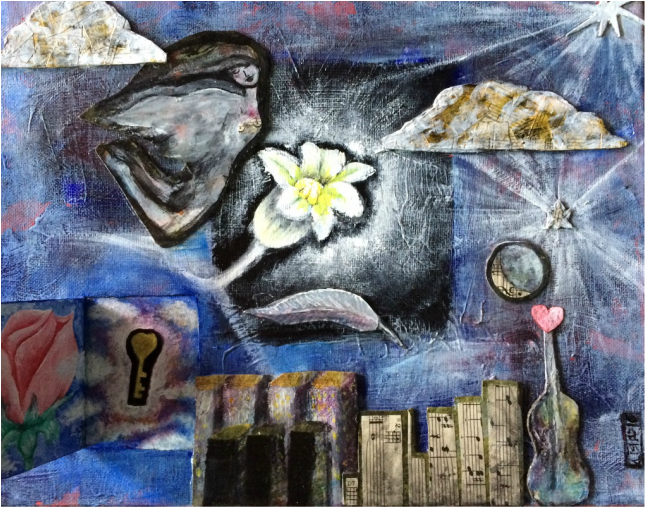
Painting by Laura Pierre-Louis.
Interlectual Property (with an “r”) is a contrived term we’ve co-opted from the world of deep science startups. Merriam-Webster defines Intellectual Property (with an “l”) as any “property (such as an idea, invention, or process) that derives from the work of the mind or intellect.” Disruptive Intellectual Property is key to a deep tech startup’s competitive advantage and typically protected through patents.
Your personal Interlectual Property, or IrP for short, also includes creative ideas that distinguish your grand ambition from the fray – my hip laundromat will offer a beer bar, used book library, and live music! – plus other resources that support your pursuits: money, education, contacts, specialized equipment, location, etc. Getting these down on paper helps display what you have, and even more critically what more you need to develop a compelling, successful effort. (Fair admission: we just like the work Interlectual.)
Buckets
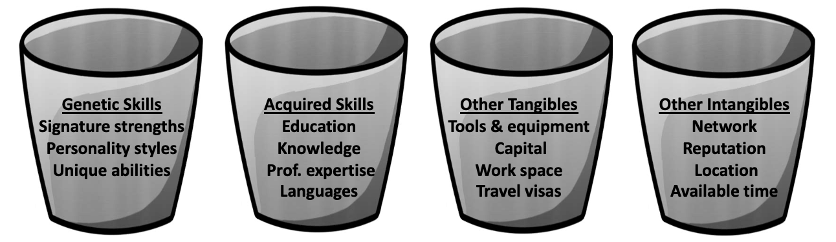
When surveying your many resources to exploit think about these 4 buckets as a starting point. The contents will differ depending on your own unique history.
Bucket 1 is a collection of your natural signature strengths, personality style, and unique abilities gifted from birth. Why identify your natural strengths? Playing to them will give you an inherent advantage from Day 1 and help advance your efforts more effectively, which feeds confidence, which encourages an even bigger effort; a virtuous cycle.
The great sages of optimism, such as Martin Seligman (“Flourish”) and Mihaly Csikszentmihalyi (“Flow”) agree that building on one’s natural strengths is key to personal growth and fostering authentic happiness. Knowing your strengths – natural and learned – also reveals the holes in your game, which can filled through purchase or additional training.
Many different evaluations have been developed to define and measure strengths and styles. Two that we like and use in our Life Leap Workshops include:
The VIA Survey of Character Strengths, available here at UPenn’s Authentic Happiness Center. This test provides a ranking of 24 signature strengths that define your authentic power base. Bravery, fairness, creativity, honesty, and 20 others are included.
The Enneagram Personality Test, available here at Truity. The Enneagram is a set of 9 personality types. Perfectionist, peacemaker, enthusiast, and 6 other classifications are included. You’ll find a bit of yourself in all 9, but one will capture your true signature style with startling accuracy. While Truity offers an online test for free I recommend having a professional take you through an evaluation for a much deeper and thorough reading. Contact me for a reference if needed.
Bucket 2 is a collection of those learned assets acquired through life. Some may prove essential to your encore ambitions, some not so much. It’s a valuable exercise to list them all. Your grand ambition in 6 months may be different than the one today, and some former skill sets may suddenly find new relevance.
Bucket 3 is a space for all other major tangible assets that have value, whether or not for the legacy project you’re considering. Money is always helpful, as is specialized equipment, especially for artistic endeavors.
Through a life of writing, performing, and recording music I have a collection of quality guitars, amplifiers, microphones, and recording equipment (my wife Alexandra had deep reserves of patience, definitely one of her signature strengths). This equipment is valuable for my encore ambition to get a rock musical produced and staged, and some pieces are indispensable as well for recording podcasts and short videos for my Interprize Group-related work.
Gratuitous photo of Aix-en-Provence.
Bucket 4 may require some creative thinking. Intangible assets in the business world include items like goodwill and unique knowledge/know-how that can’t be easily quantified. They are not physical and can be challenging to appraise. But there may indeed be real IrP value in the network of friends and professional contacts you’ve cultivated through the years, and the appreciation these people have of you. Hey,I’m working on a bold life ambition of very deep personal mean, … and I need a favor. Absolutely!
I live in a stunningly charming city – Aix-en-Provence – in one of the most appealing geographies in the world – the south of France. It’s a life choice, not strategic decision, but I would be wasting a fabulous asset if I didn’t leverage this location for Life Leap Workshops and other gatherings. It’s a big selling point that has an incremental cost of 0 to me (I’m living here anyhow). People just naturally want to visit. No arm twisting required. Put it down as an intangible!
Last month we talked about different experiments you can run to bubble up ideas on purposeful legacy ambitions. By now you should have at least a solid sense of Mission, a North Star piloting possibilities and plans. This experiment will reinforce those considerations by identifying the resources you can draw on now and those you’ll need to acquire in that pursuit (or pursuits if multiple).
Create your 4 bucket lists of skills and assets as outlined above. Take time to fill them thoroughly with the major assets you have acquired through life, including both those that should be helpful with current ambitions, and those that are not at the moment, but may prove valuable in the future.
Revisit your Mission Statement and motivations from Experiments 1 – 3 and identify those assets listed that are key in the pursuit of your Interprize; your bold life pursuit.
Create a new list – of assets needed but not yet acquired – and determine how you can attain them: buy them, learn them, ask others who have these skills or assets to join your effort, or other options.
Formalize you IrP strategy:
IrP you have
IrP you need
Your plan for filling in the holes
Don’t avoid leaning on your community of friends and family for support strengthening your abilities and assets. Study after study have shown the importance of personal relationships in building optimism and life enrichment, including this recent 85-year definitive study by Harvard (click here for the article in the Atlantic). If they love you they’ll want to help, … and they do.
There is no greater agony than bearing an untold story inside you. – Maya Angelou
This is #3 of 12 experiments for the year, offered to get you inspired, thinking creatively, and organized in the pursuit of bold life ambitions of deep personal meaning. Experiments 1 and 2 concentrate on the big question of WHY (aspire to live and leave a life respecting your greatest gifts and passions). They provoke you to think about life – your ideal versus the current version – and death – those things for which you want to be remembered as you pass into the great goodbye.
This March Experiment starts the migration of WHY to WHAT. If you’re still reading these essays then you’re likely loath to the idea of retirement years spent in the wading pool. That deep end of the grand basin feels risky, but damn if that diving board doesn’t look fun. WHY make the effort to mount the board, muster some courage, and take the leap? WHAT will you find at the bottom of the pool? Onward.
Is it important dive deep, especially if after a life of impressive achievement? I argue that it is for at least 4 reasons:
1. Midlife is the best moment to dream big and realize your authentic self. You likely have some stores of savings, the kids are gone, your network is extensive, health is still good, mind is still sharp, time is available, and your life experiences have a bestowed a wisdom to which your younger self had no access. Are you going to waste this golden moment?
2. Your accomplishments to date, impressive as they may be, may not reflect the untold story inside you. Amazing mom, corporate CEO; both and many titles in between are impressive laureates. If that’s all that needs be told and you’re fine with that résumé on your stone block, god bless and job well done. If not, there’s no better time to start on a new epithet. (See point 1.)
3. You’ll likely live a longer, richer life. Study after study of repeatable, empirical evidence reveals that pursuing authentic life purpose is a key to happiness, good health, and more days on top of the dirt. Just a few sources include centers of research led by Martin Seligman (UPenn), Sonja Luybomirsky (UC Riverside), Barbara Fredrickson (UNC Chapel Hill), and the Greater Good Science Center at UC Berkeley. The results of an 85-year Harvard study published just last month show that the essential ingredients to longer, happier lives orbit around positive relationships. And one key component of these is the personal growth enjoyed from the pursuit of purposeful life goals, shared with those you love.
4. The world needs your gift. There is so much beauty and so many problems in the world today. Perhaps your gift is artistic expression, perhaps it’s helping people in need, maybe it’s retracing the voyage of Kon-Tiki in a balsa log boat. Regardless, we all benefit. Jimmy Carter stands at the gate to ascension as I write this note, in hospice care back in Plains, Georgia. He was President of the United States; the most powerful man on earth. Now that’s a colossal accomplishment on which to call it a day and retire to the Palm Beach club set. But Jimmy’s legacy had only begun. Nobel Prize recipient, tireless human rights and healthcare advocate, green energy pioneer, Habitat for Humanity founder, and loving husband and dad. We’re going to need a bigger headstone! He will leave this world a much, much better place for all of us to live.
What to do, what to do
Some of us know well our deepest passions and where purpose resides. We understand our gifts, have dabbled with daring projects, and hold a solid sense of how to make a difference. Some of us have no clue. The most of us are somewhere in between.
There are an endless number of books available on uncovering your purpose (see additional reading below). I offer here 3 exercises on Options, Motivations, and Activities that will be helpful in surfacing possibilities should you be in that not really sure category.
Exercise 1: Options (let’s boil the ocean, shall we?)
1. List all previous existing ideas of hobbies, passions, or curiosities that you’ve considered pursuing when you had more time.
2. Identify enjoyable activities from your career. What parts of your jobs did you love doing (as opposed to those you dreaded)?
3. What activities put you in a Flow state; that is, when engaged in them your strengths are challenged and mind 100% immersed, numb to other distractions, and you lose all sense of time.
4. What’s on your bucket list if you have 12 months to live?
5. What types of roles, activities, or responsibilities do you want to avoid?
6. Compare these lists and look for themes.
Exercise 2: Motivations
What is driving you develop a greater sense of purpose? Why commit your energy, spend your savings, and abandon the easy life for a more deeply engaged life? What are your motivations?
This is a short list of 33 possible motivations that may be driving you, just a slice of total possibilities. Create your own, select 5, and look for themes.
Exercise 3: Activities
Create a table of activities from your career or life roles and identify those that you enjoyed and those that created the greatest discomfort. The table should include your job/role title, activities performed in each, and focus of those activities. Circle the activities you enjoyed and strike through those that you did not. Look for themes.
In my professional career I was an analyst, investor, and professor and I present my own table here as a sample.
Your Mission
These exercises may not uncover a specific project, but should be effective in setting your North Star. In the business world this is referred to as a company’s Mission and revealed through a Mission Statement. (Some life coaches refer to it as a Vision Statement; take your pick.) It has little to do with what a company actually produces, but succinctly encapsulates its core customer value. Three examples:
To create happiness for people of all ages, everywhere.
To accelerate the world’s transition to sustainable energy.
To encourage and enable the pursuit of bold ambitions of deep personal meaning.
Nowhere here are specific products or services mentioned. Nothing about theme parks or electric vehicles or life leaping programs. But everything these companies do will align with their Mission Statements. If not, either the statements or the offerings must be reconsidered.
You should be ready to take a first pass at your Mission Statement if you’ve worked through the exercises above. What value will you offer the world and how will it tell that story inside? Focus on value not product or specific project. Think about your customers. There may be millions, there may be just 1: you. This is your life, your bold ambition, your interprize. What will it give us? Where will it lead you? What’s that North Star?
Additional reading
There is an endless list of books written on the topic of finding life purpose. No single one is considered the definitive work. I’ve read just a few and these are some titles I found particularly helpful:
Finding Your Element: How to Discover Your Talents and Passions and Transform Your Life. – Ken Robinson
The Encore Career Handbook: How to Make a Living and a Difference in the Second Half of Life. – Marci Alboher
Suggested Song: That Was Me, Paul McCartney Suggested Drink: Guinness Extra Stout (The Irish have mastered a good sendoff)
This is the second of 12 experiments I’m proposing to readers this year; one per month. If you’re intent on making 2023 a pivot year toward more purposeful ambitions, or perhaps just asking that post-Covid question – okay, what now and how? – these experiments will help draw maps, uncover truths, enhance motivation, strengthen resilience, and be fun. All are part of the Life Leap Workshops we run in Provence (more about those here). Please give them a try and let me know what you learn and how they can be improved. Comments and critiques are encouraged.
I need to start this essay by highlighting the good fortune we all have, those of us in a position to think about passion pursuits and life purpose. Close to a billion people on this planet are too damn hungry to think about self-actualization. Double that number when including conflict and war zones. Where do I find my next meal and how do I keep my children alive? There are a few Ukrainian families here in Aix – mostly moms and their kids – trying scrape together some way of paying rent while avoiding bad news from the front. What would the hungry and harassed give to be at the peak of Maslow’s pyramid? So, with much humility and respect, onward.
Eulogies
Damn it all, plunked in. On the gravestone of Andy Loy (A colorful character from Bill’s childhood)
The January Experiment (Missed it? Click here.) dealt with the Wheel of Life. It’s a helpful tool to examine how well your current life aligns with the ideal life you imagine. For February we fast forward the reel and talk about, …. death. I don’t mean to be darkly provocative. After the final pulse, there will be a day for others to a cast warm light on your life. Your eulogy, the Cliff Notes version of greatest hits; if you die tomorrow will it recount the legacy you want to leave? What does this say about the life you’re living now?
She started a soup kitchen that fed 100s of homeless and hopeless a day.
His films made viewers rethink the black experience in America.
They restored by hand an old, dilapidated French farmhouse into a world-class BnB.
You will have a eulogy, a moment for friends and family to have a final say on your final day. Maybe even an obit! If there’s one thing we all agree on: no one gets out alive. The question then is, do you want some influence over said commemoration? Specifically, do you care about how you will be memorialised by those at the pulpit for them in the pews?
Artist unknown
The only option for that input is the legacy of material you leave behind. How you lived your life, whom you touched, and what you created: that’s what will be so fondly recalled, not necessarily the same how’s, who’s, and what’s you hoped for. Others – family and close friends – will be climbing the sanctuary to sing your praises. They’ll want to spin some magic. So give them your magic. Make their job fun.
This experiment, then, is a valuable tool for considering purpose, potential, and progress (gotta love the 3 ps). Why you’re here, why you want to be here, why you mattered. And we all want to have mattered.
How is your eulogy lining up? Here’s a quick, back-of-the-envelope experiment for a quick gauge.
The My Eulogy Experiment
Step 1: Your ideal eulogy.
1. Calmed with a warm cup of tea (or chilled glass of rosé) imagine the contented end. Slipping peacefully into eternal slumber, your purpose has been realized, deepest passions fed, your legacy secured. Yes, that WAS a life lived richly, with little left on the plate. And you’re confident that those things that mattered most will be mentioned at your funeral as a true reflection of who you were, how you served, and why a glass raised in your honor is well earned. (If you practice mindfulness this step is a perfect meditation for that zen state.)
2. On a piece of paper list 10 highlights that most merit mention. This is your ideal life list, so include endeavors and achievements from the past for which you are proud and ambitions for the future to which you are committed. Rank them from 1 (essential and non-negotiable) to 10 (important but less critical).
3. Look at the list. Are these truly the 10 highlights to include? Are they authentic and possible (your memorializers will sympathizers, not fabricators)? Ranked properly? Come back to the list later in the day and then again tomorrow, and each time check for correctness. As with the Wheel of Life, don’t consider the ideal eulogy highlights finished until you’ve had a chance to review them over a couple of days, at different times of the day, in different moods.
Step 2: Your current eulogy.
1. In a similarly calm state take a second piece of paper. Rank the high points of your life to-date most likely to be mentioned should you die tomorrow, from 1 (almost surely) to 10 (possibly).
2. Review the list a few times over a couple of days to make sure you’re not forgetting something and have a proper ranking.
Step 3: Compare the lists.
1. For highlights that are on both lists and at similar levels, bravo, your attention and energy are being directed appropriately to those things most important for your life legacy.
2. For highlights on both lists but at notably different rankings, what can you do now to start a correction?
3. For highlights included on your ideal list but missing from current, what’s the plan to get something launched? (That’s our specialty at the Interprize Group, you should ping us!).
Hachiro Kanno
The toughest part of this experiment will be coming up with your list. At first you may think that 10 things about you don’t need to be mentioned, and then you may feel that 10 isn’t nearly enough. Grand passions and life purpose and big achievements are all amazing to pursue, to have on our final resumé. But in the end we just want our lives to have mattered. Helpful grandmother, acclaimed author, much-loved and trusted kindergarten teacher, national champion, …. How did you matter?
Suggested Song: Find Yourself, Brad Paisley Suggested Drink: Virgin Mojito (staying in theme with my dryish January)
With this year’s series of essays I’m going to offer 12 experiments; one per month. For readers intent on making 2023 a pivot year toward more purposeful ambitions, or perhaps just asking that post-Covid question – okay, what now and how? – these experiments will help draw maps, uncover truths, enhance motivation, strengthen resilience, and be fun. All are part of the Life Leap Workshops we run in Provence (more about those here). Please give them a try and let me know what you learn and how they can be improved. Comments and critiques are encouraged.
Each new year starts with our best intentions. Less of this, more of that. Back to basics, forward to the unexplored. Revived projects and new ambitions. Reinvention.
You may be sketching out plans now. They may get realized, maybe not, perhaps not even launched. One thing is assured: nothing deserved of your very limited time and energy – which are infinitely more precious than money – will magically self-organize. If you want to do something purposeful and grand this year, if that’s a resolution, then you need to organize a plan, even if futile.
Start with your foundation.
The Wheel of Life
It’s been over a decade since I left the cable cars and golden gates of San Francisco for the lavender fields of Provence. For 30 plus years I had been living the dream in the Bay Area’s tech and investment industries, as a laser jock and analyst and banker and venture capitalist, and I absolutely loved it until I didn’t. When that unsettling mid-life question – is this it? – began to itch in places I couldn’t scratch it was time dig deeper, beyond the surface stuff like money and security and title and possessions, and seek out genuine authenticity.
San Francisco State University had an executive ed program on life coaching back then and the night courses opened up a whole new universe of questions for me. Are you happy? Does happiness matter? Who is in control of your life? What are your core nonnegotiable values? What is your personality type and why is that valuable to understand? Most importantly, what tools are handy to disassemble and reflect on considerations such as these, and to help ferret out some answers?
On the first night of the first class we were introduced to the Wheel of Life. It provides a graphical segmentation of how your finite stores of time and energy and attention are being parsed. You can fill one out for your current situation and another to represent the ideal life. Comparing the 2 is particularly insightful in understanding how truly offtrack your life has become (perhaps not at all, but then again…), and where adjustments should be concentrated; that is, assuming you want a life most closely aligned with your core priorities and interests. (You do.) By the end of this first class I was feeling feverish and plotting Life of Bill v2.0 on the MUNI streetcar ride home. Within 12 months I was living in Provence.
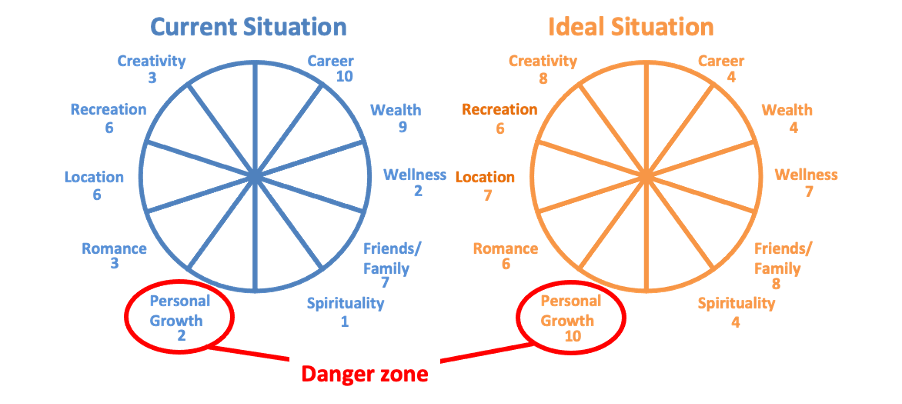
The Wheel of Life is a circle segmented into 10 slices that collectively represent how your time and energy is being consumed; at least with the 10 most pressing elements. The following chart is an example, but your elements might be different. Some slices are common to most people: Health and Friends/Family, for example. Other slices may be critical to you, not so much to others. Step 1 to using the wheel involves identifying your 10 most critical life components. Take time to get them right, then run the experiment.
The Wheel of Life Experiment
Step 1: Sketch your ideal life.
On a sheet of paper sketch a Wheel of Life similar to the diagram above: a circle segmented with 10 equal slices.
Create a list of the 10 most defining components of your ideal life; those activities when combined would consume most all of your time, energy, attention, and other resources. It’s critical to get the right components, so take time here to think this through. (Your favorite café or wine bar might be an inspiring workspace for this exercise.) In your ideal life you are in control, but that doesn’t mean you won’t have obligations. Include major commitment that you may not particularly enjoy but that are inescapable (caring for an aging in-law could be an example). It’s also the moment to consider what is and is not truly inescapable. (This can lead you into dangerous territory. Go with it for this experiment.)
For each of the 10 elements, assign a weight as to the attention it would consume in your ideal life on a scale of 1 (very low attention) to 10 (very high attention).
Assign each element to a slice. Write the 1-10 weighting under each element label, and fill in the slice with a crayon or marker reflecting that weighting starting at the center. An allocation of 10 will fill the slice entirely. An allocation of 1 will barely fill it at all.
Look at your chart. Are these the 10 critical components to include? Are they weighted honestly? Come back to the chart later in the day and then again tomorrow, and each time check for honesty and correctness. Don’t consider the ideal wheel finished until you’ve had a chance to review it over a couple of days, at different times of the day, in different moods.
Step 2: Sketch your life now.
On a second sheet of paper sketch a Wheel of Life that reflects your life now.
You must use the same 10 elements as included in your ideal life wheel.
For each of the elements assign a weight to the attention it consumes in your life today, from 1 to 10.
Fill in the wheel to reflect this weighting, as in number 4 above.
Review the chart a few times over a couple of days to be comfortable with its completion.
Step 3: Compare the 2 life wheels.
Place your 2 wheels next to each other and contrast the profiles.
For twin slices within 1 point of difference, bravo, your current and ideal situations are well aligned. Keep it up.
For twin slices between 2-3 points of each other consider what can be done to move your current situation closer to the ideal. Small tweaks may work wonders in lowering the weighting tension. Experiments that we’ll be running in future essays this year should be helpful.
For twin slices that are 4 points or more apart, danger ahead. The tension between your ideal life and current situation may cause serious complications in the future (emotional, physical, relational); they may already be giving you an itch that can’t be scratched. Some things in life are out of our control (I argue that this list is smaller than most believe), but seeing your misalignments visually is valuable should they provoke an effort to ease the friction. (At a minimum, toast yourself for soldiering through the inescapable.)
The following chart could have been my Wheel of Life experiment 15 years ago (with the slices colored in). Some misalignments created alarm, then determination, then action. What will yours incite?
Suggested Song: I Thank You, Sam & Dave (See ZZ Top’s amazing live rendition, 2011) Suggested Drink: Your favorite herbal tea. (Pure joy on a cold night with a good book.)
Piglet noticed that even though he had a Very Small Heart, it could hold a rather large amount of Gratitude. – A.A. Milne
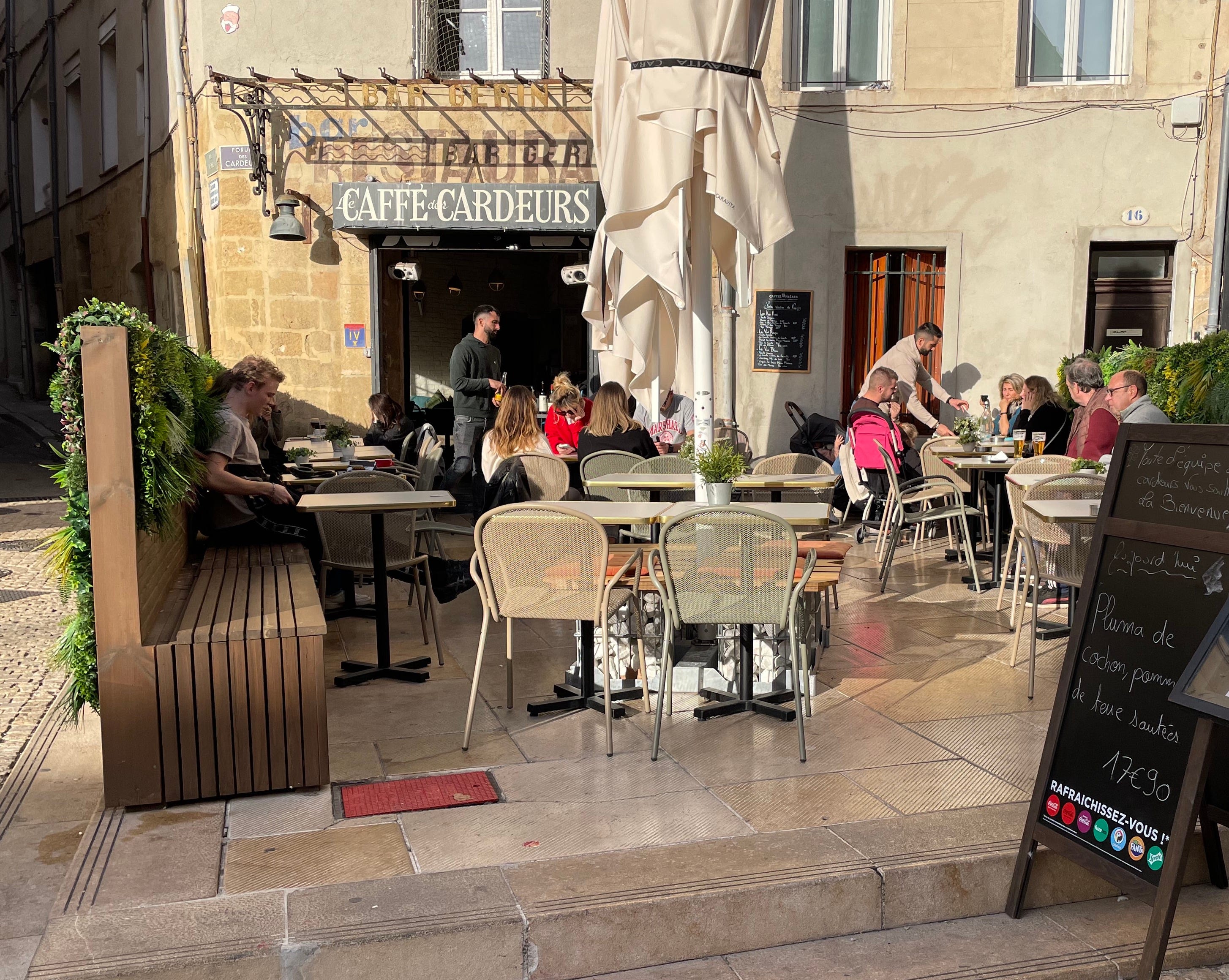
The Place des Cardeurs is the largest open plaza in Aix-en-Provence. A city block long and half as wide, the Cardeurs is ringed by restaurants and cafés and wine bars and beer pubs and gelaterias. It’s dining and drinking al fresco; open air in the summer, then under those large canvas and plastic tents the French have mastered through the years. Eat inside? But how would I smoke?
Weekend evenings in the Cardeurs are loud and collegiate, with throngs of students (there are over 30,000 in Aix) enjoying cheap drinks deep into the night. A chorus of laughs and chatter under strings of festive lights. Sundays awaken quiet and calm, with families and kids commandeering the massive terraced savannah, now void of the sea of tables and chairs from the evening’s bacchanalia. Off you go Junior, run that endless battery down while your mother and I enjoy a slow coffee.
It is to the Place des Cardeurs one comes for that Sunday afternoon glass late in the season. For, with its large expanse and low-slung periphery of buildings, the Cardeurs is the most promising spot in town to catch a few fleeting rays of hibernal sun. It seems to barely reach mid-sky during the Provence winters; a lazy ball that’s up late and done early. But it manages to arc just above the south-facing roofline through the afternoon, casting silhouettes of the tangle of unemployed antennas and vent pipes and chimneys.
Caffe Cardeurs, mid afternoon on the last Sunday of November, 2022
The Winter Mood
Darker, colder days like these can shroud a winter malaise over the cheeriest amongst us. I tend to stay buoyant but have family and good friends who can get gloomy, and I have seen what a demon that can be to wrestle. I follow a winter strategy to fend off despair: (1) lean into the season and (2) inoculate against melancholy with a regime of winter indulgences and rituals.
I lean in mostly with what I eat (lots of stews and soups), when I sleep (early), what I read (long tomes for long evenings), and whom I see (just a lucky few). As for rituals, I light the apartment with candles, spend money on bath salts, listen to Coltrane and Chet Baker while making dinner, and take an inside table at Lulu’s (click here for her menu of the week). These things I never do in the summer, except for the occasional Baker.
Rather than resisting the seasonal change, you might try embracing your winter hermit with arms wide. Retreat into your cave. Build your books-to-read stack. Re-up Netflix. Knit (kidding, consider any home craft). Nest. Bears do it. Squirrels do it. I do it. Try it. Spring will bring a sharper contrast in light, warmth, friends, and merriment. The buds and blooms will seem somehow more extraordinary, more appreciated. (For a fascinating rumination on hermitude and recluses read Michael Finkel’s A Stranger in the Woods: The Extraordinary Story of the Last True Hermit.)
Your Best Defense Against the Blues
The Thanksgiving holiday is a reminder that beyond the turkey and football (in both variations this fall), gratitude is a healthy addition to the winter regime. Giving thanks is the low-hanging fruit of happiness and effective at fending off the winter blues. If you need a positivity boost when the days are dark, expressing gratitude is the easiest and most impactful ritual you can adopt. Its power in building resistance to the dark side has been studied extensively.
Through his cutting-edge studies, Robert Emmons, professor of psychology at my alma mater UC Davis, has shown that gratitude “can lower blood pressure, improve immune function and facilitate more efficient sleep. Gratitude reduces lifetime risk for depression, anxiety and substance abuse disorders, and is a key resiliency factor in the prevention of suicide.” All can feel acute in the dark months. His findings match those by other thought leaders in the happiness field, such as Barbara Fredrickson (UNC Chapel Hill), Sonja Lyubomirsky (UC Riverside), and Martin Seligman (UPenn).
Gratitude journals, gratitude letters, gratitude circles; these are just a few of the options available to practice the practice, something we do in our Interprize workshops. You can find endless links to infinite articles online about this stuff. For more rigorous findings and suggestions, search on the names in the previous paragraph. What works best for me: a simple end-of-the-month inventory of people and things to which I am grateful. I keep it short – 5 or fewer – and don’t dwell on what or who misses the cut, … there is always next month.
If interested in the Bill Magill November gratitude list, I offer it here in no certain order. This past month I have been deeply grateful for:
1. My adventurous grandparents’ talent at staying alive (or I wouldn’t be typing this now). My maternal grandfather managed to survive the trench warfare of WW I as part of the Canadian forces fighting in France. About 67,000 of them didn’t make the return, another 4x that number were injured. Chances of making it home unscathed was less than 1 in 2. He was short and perhaps that helped keep the helmet low. Papa made it home.
My fraternal grandmother, just out of college, travelled south to teach at the Calhoun Colored School in deep Alabama in early 1900s. She was part of an alliance of northerners committed to the education of post-slavery children in a deeply segregated south. The Klan were no fans of such enlightened idealism. Educated white women elevating poor black kids; what was next, the vote?! As that wasn’t enough excitement, she later took a steamer from New York City to Alexandria, Egypt, alone, and then continued on to the Sudan where she married my Irish grandfather, traveling amongst the villagers and crocodiles and malaria. They made it back to the US in 1 piece, had a pack of kids including my dad, and in 1957 my tiny zygote squiggled into the world.
2. The brilliance of the classic novel “A Confederacy of Dunces. It kept a grin planted on my face through the entire month. Sadly, its author John Kennedy Toole ended his life in 1969, shortly after completing the novel. It took his loyal mother 11 years to find a publisher, but his genius and her perseverance were awarded with a Pulitzer posthumously in 1981. (Many thanks to Canadian Dave for lending me his dog-eared copy.)
3. My daughter’s impulsiveness. This call I got in October:
“Hey dad, I had a great tip week at work and was thinking of coming for a quick visit.” (From LA.) “Fantastic Stella, when?” “Uhhh, tomorrow?”
Melt.
Fortunately her mother works for United Airlines. You gotta love those standby perks.
4. The American voter and US court system for protecting that right. The large slate of kooky candidates running this fall on a platform of 2020 election denial – one has to admire this cult’s tenacious cling to disproven fantasy – was universally denied at the ballot box. And the courts, up to the Supremes, shot down the many attempts across numerous states at voter suppression. The people’s voices were heard and counted. Democracy triumphed. Whew!
5. The craftsmanship of my Martin guitar. I bought this D35 acoustic in 1989 new, an MBA graduation gift to myself (Bill, you are so amazing you deserve a reward!). With its lifetime guarantee I can walk into any certified Martin repair shop around the world and have it refretted, trued out, and tuned up for free. Its tone has only gotten warmer through the years and the body of spruce and Brazilian rosewood still looks beautiful. If curious to take a look see I made this tutorial video last week on how to play Little Bird. Even with the cheap recording acoustics of my tiny iPhone its sound quality is unmistakable.
Suggested Song: Changes, David Bowie Suggested Drink: Shapeshifter cocktail: vodka, crème de violette, lemon juice, bitters, egg white.
I had an essay on psychogeology planned to drop this week (yeah, it’s a thing!), but two new biographies of Anthony Bourdain have provoked me to the point of making a last-minute swap. Extracts from the biographies are making the rounds, their authors giving interviews.
Bourdain had a large fan base to which I subscribed. Kitchen Confidential was an irreverent exposé of restaurant kitchen culture; a raucous reveal behind the twin swing doors. He reveled in shining a light on the soiled underbelly of something carefully manicured and disneyfied. Bourdain was the essence of punk insolence and I was punk rocker at the time. I ate it up.
Bourdain’s own brand was manicured as well: culinary rapscallion; acute observer of the absurd; globetrotting seeker of the strange and spicy; unapologetic provocateur; cool older dude with hot younger girlfriend. I can imagine that this fun stamp could be exhausting to maintain. We all evolve, sometimes to our friends’ and fans’ resistance. Schwarzenegger’s bodybuilder begat terminator begat governator. The Beatles graduated from Can’t Buy Me Love to A Day in the Life. Fans were unhappy, but the Fab Four were done with holding hands and love me do. Happiness is a warm gun. Transformation is essential for staying fascinated by ourselves.
Bourdain was reportedly excited about a new project that would be decidedly un-Bourdainian. Even pirates pull down the black flag at some point. One can imagine how liberating it would be, and befitting of his style, to shock the devotees with something unexpected and completely out of character. I spent 20 years cultivating X and now I’m Y. Trust me. Join me!
In an earlier incarnation I had a privileged life in San Francisco. It was the greed-is-good Gecko era and cred was built around possessions and title. My wife kept me grounded but every peacock loves to spread the feathers from time to time.I found my wings when I severed the strings (a lyrical couplet from the 2021 MASSIVE HIT To Say Goodbye) and moved to slow-and-sunny Provence from fast-and-foggy San Francisco. I knew that my professional repute and financial surety were about to become irreparably unwound, and was elated. For I was moving towards a more natural, authentic version of myself; correcting course towards a north star I had always seen brightly to the side and too long denied. At a certain age denial is a very unhealthy choice.
My sense is that Bourdain was a mostly authentic guy but yearning to evolve. He was an undeniable creative and creative types don’t like being boxed in. The slightest tinge of I’m starting to feel fake elicits the hives x10. Maybe he was finding it difficult to shape the shift, given the heavy momentum of his much-loved brand. Certainly his open history of substance issues and depression wouldn’t have helped, and his relationship was reportedly on the rocks. He loved her deeply (according to the new bios) and must have felt it slipping. That can push one into embarrassing behavior. I can relate more than I want to admit, and perhaps is why I felt compelled to pen this rumination.
We all need to be aware of the gravity of our brand and the effort required to escape said pull, if indeed that’s what is needed to grow and thrive. It’s a very healthy thing, mandatory I’d suggest, to question our identity regularly and tweak where needed; destroy when required. If surrounded by people who love you in a place that nurtures you then you’ll be fine. Actually, much better than fine, you’ll be alive.