I finished 2023 in a harried frenzy to get 3 new books into the world. I am as committed to deadlines as I am distracted at meeting them. But met them I did (with help and prodding from family and friends) and here are the results, with a short promo blurb on each. All of these books are available on the Books page of my Interprize Group website.
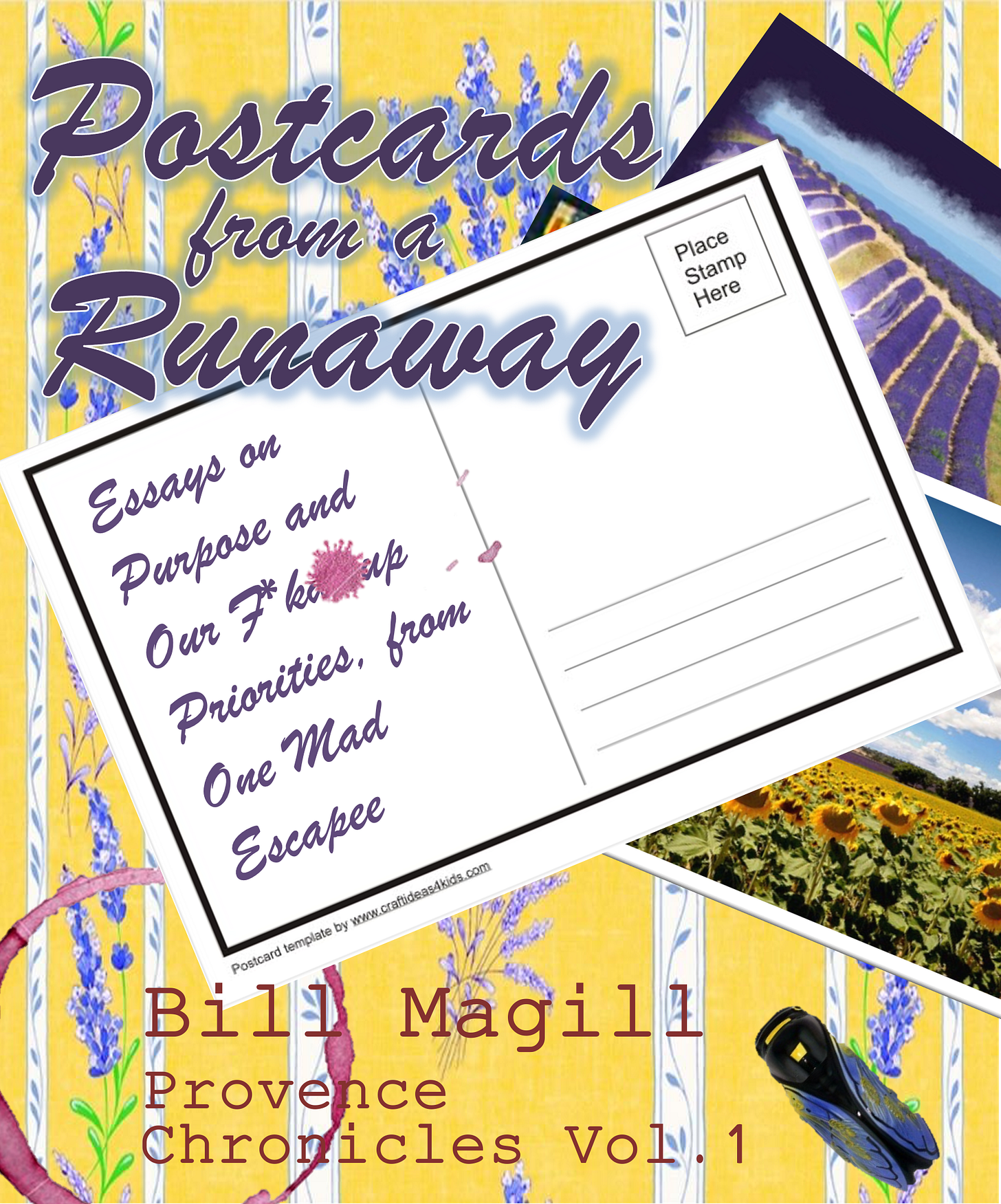
Postcards from a Runaway, Provence Chronicles Vol. 1. (2011-2013)
At age 50, I walked away from a high-profile investment career and a lifetime of accumulated stuff and relocated to Provence, France. I was in search of a simpler, deeper, more authentic life, … one full of passion and a richer sense of purpose. Writing became part daily structure, part self-therapy, and laid the foundation for a collection of essays – postcards – on bewilderment at midlife and the search for what truly matters.
This compilation of the first 30 postcards chronicles the early experiences of my new life in the land of rosé and lavender fields. Compilations of subsequent essays will be released through 2024.
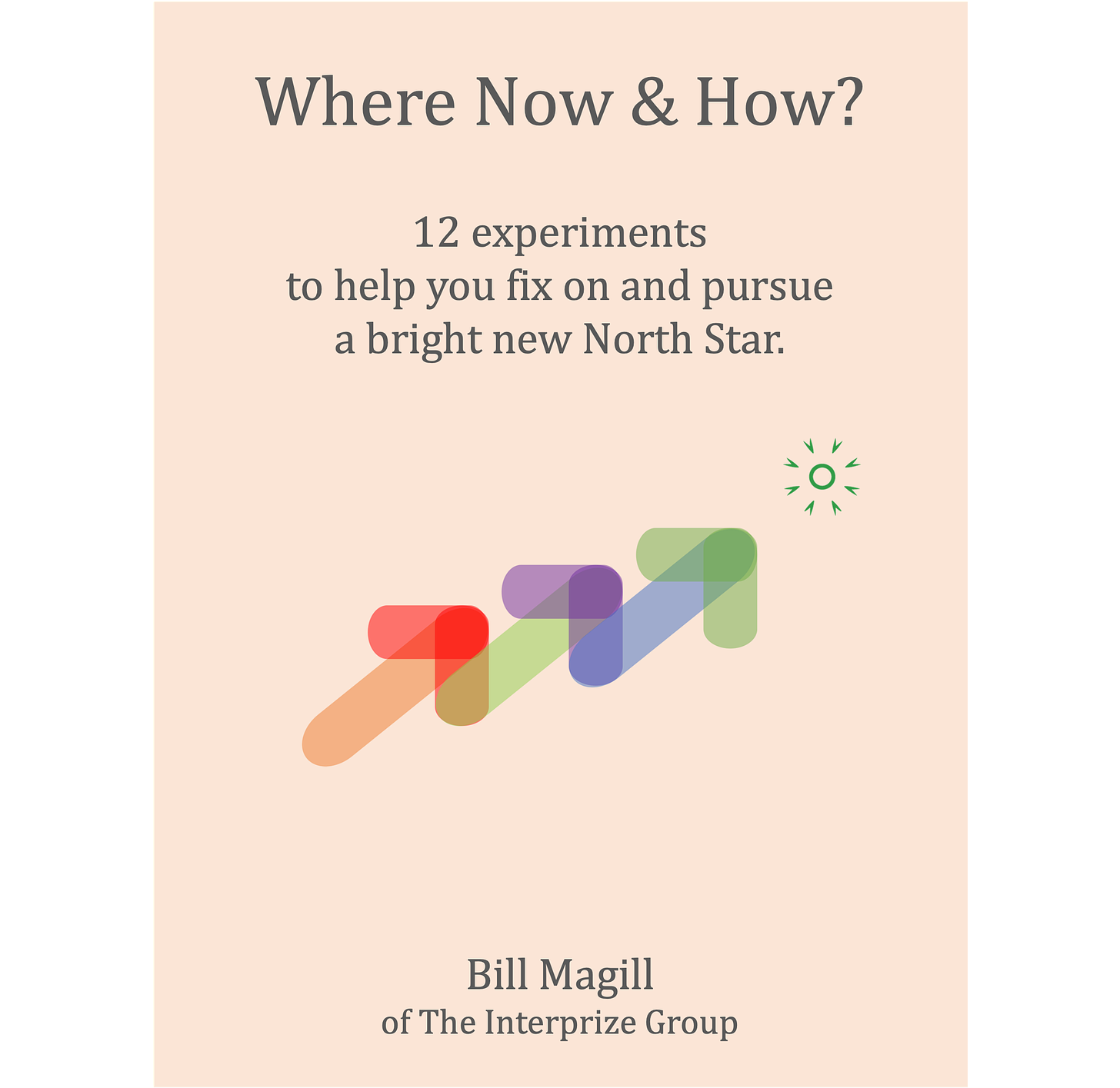
Where Now & How?
Through 2023 I wrote a series of 12 experiments for those at a life inflection point and imagining a pivot toward grand, unexplored ambitions of deep personal meaning. These 12 experiments, published monthly here on my Substack, were intended to help you draw maps, uncover truths, build plans, fuel motivation, strengthen resilience, and have a lot of fun.
The posts have been compiled into a book – “Where Now & How?” – for easier reading. Note that audio versions of these experiments are only available in the original Substack posts.
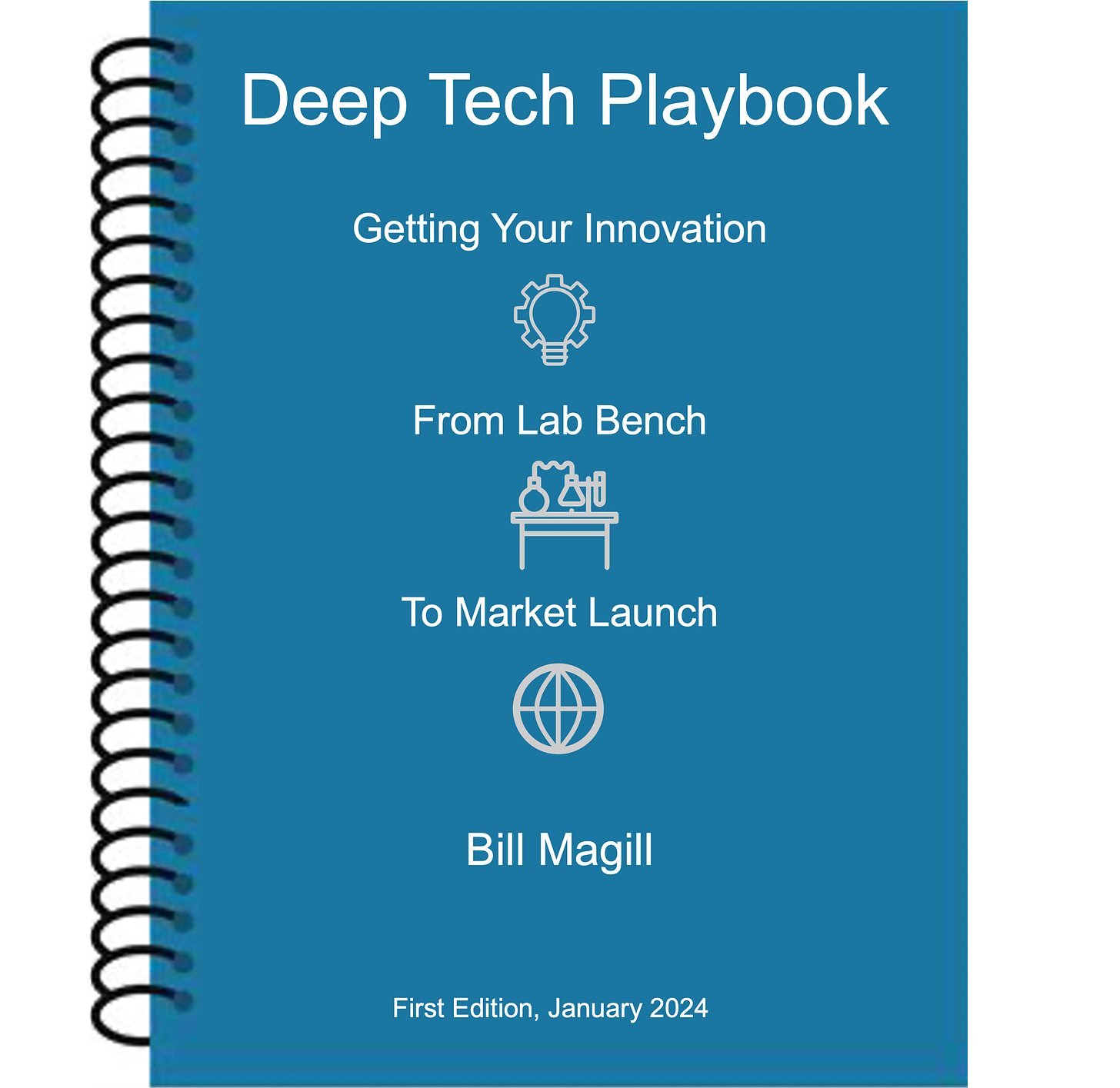
The Deep Tech Playbook, First Edition
One hat on my rack is that of university professor. More specifically, I teach courses and lead workshops on the topic of technology commercialisation; how to create a startup around a deep science innovation. The “Deep Tech Playbook” is an action-oriented manual that provides a step-by-step guide to the market and product essentials for the commercial launch of science-based innovations. It will help aspiring entrepreneurs build go-to-market strategies for their deep tech disruptions. The Playbook is based on my 25-plus years in the industry, mentoring founders, investing in startups, and co-leading programs on the art of deep tech venturing at INSEAD, one of the world’s leading business schools.
Many new projects beckon for 2024, including continuing my regular Substack posts and a new album drop (Side 1 soon!). I should have a new essay published by mid-month, keeping in mind my comment above about commitments and distractions. I’m wishing all my readers a 2024 marked by outlandish plans, good health, and much happiness.
Suggested Song: Respect Yourself, The Staple Singers Suggested Drink: Bud Light. A power brand making a righteous stand. Bravo!
A rock pile ceases to be a rock pile the moment a single man contemplates it, bearing within him the image of a cathedral. – Antoine de Saint-Exupery
This is #6 of 12 experiments for the year, offered to get you inspired, thinking creatively, and organized in the pursuit of bold life ambitions of deep personal meaning. This mid-point experiment focuses on your brand; aka, that perceived image the world holds of you. I don’t need a brand! you say. Inside tip: you have one. Rock pile or cathedral. It’s not a question of creating your brand, it’s the importance of managing it. Onward!
Brand Management
IF you’re at midlife and considering an exciting encore career, committed to pursuing a grand (dare we say audacious!) ambition of deep personal meaning for your second act,
THEN you need a keiretsu of supporters, partners, and (possibly) paying customers THAT need to be persuaded of your dream’s merits, WHICH mean selling yourself as well as the dream.
This requires a compelling brand.
You may think you’re just writing a book. First, you’re selling the image of an exceptionally talented, uniquely insightful master of words and storytelling. Underwood on the table, disheveled bookshelf behind, contemplative stare. If not, why would anyone besides mom support your effort or buy your book? (Over 3.5 million books are published annually in the US alone; plenty of options.)
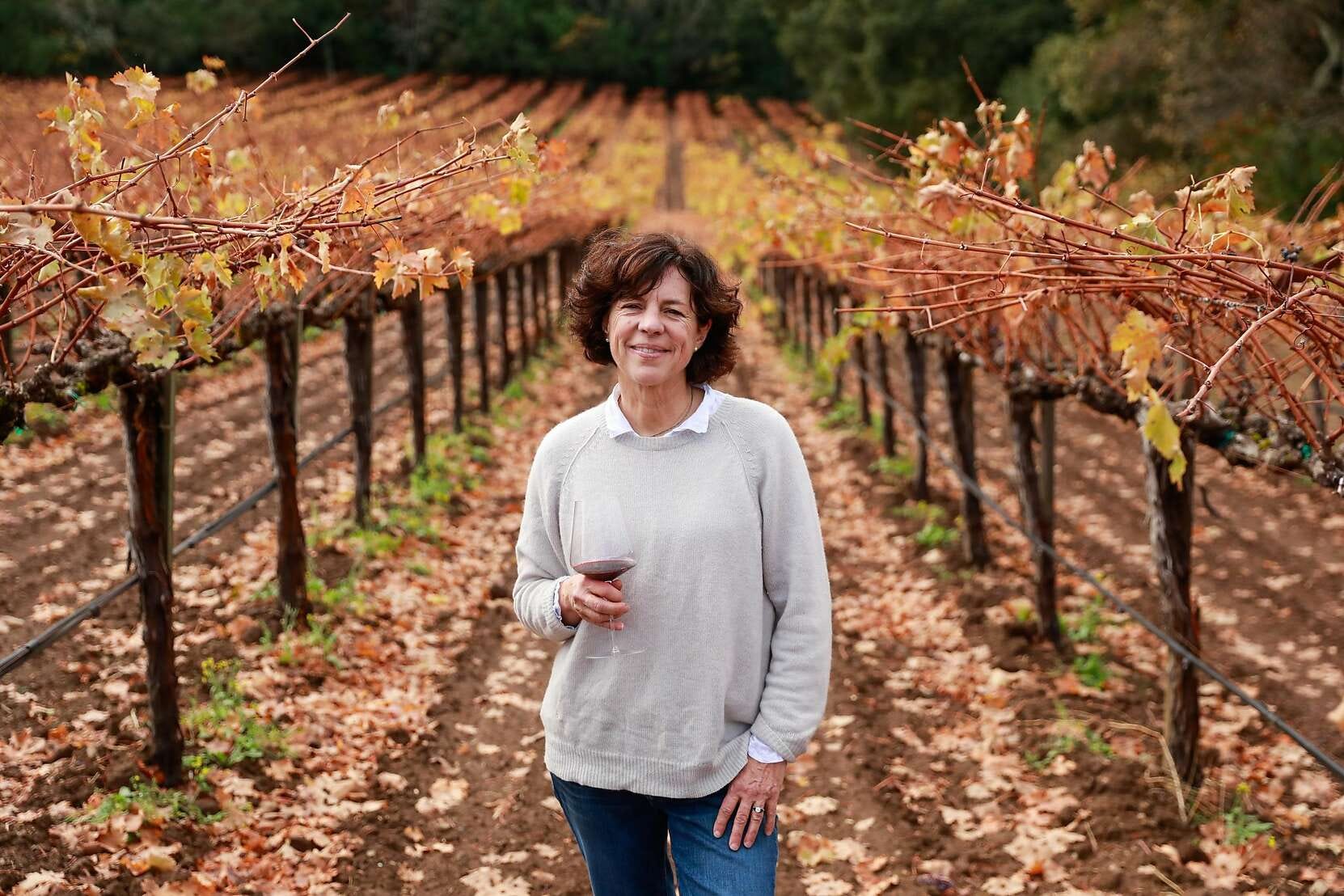
Francoise Peschon of Vine Hill Ranch, Napa Valley
You may think you’re just reviving an old, neglected winery. First, you’re selling the image of a passionate oenophile who loves tending the vines and is committed to relaunching a label with respect to the quality and history of that abandoned, storied vineyard. Tattered straw hat on head, glass of red in hand, big smile. If not, why would anyone besides mom support your effort or buy your wine? (Over 11,000 wineries bottle the grape in the US alone; plenty of options.)
You may be pursuing a dream that is completely noncommercial. Going back to school to earn an MFA in English Literature. Organizing a group climb of Mount Kilimanjaro, perhaps to raise money for Cystic Fibrosis, or maybe just because it’s there. In these and other towering ambitions you’ll be engaging with others – your patrons – and they’ll decide on the time and energy level you warrant. Warrant a lot. It will build your confidence and boost your chances of getting up that mountain. Nothing gets achieved alone.
All companies big and small work hard on their brand. Most startup founders do as well. Elizabeth Holmes, of the late Theranos scandal, branded herself as the next Steve Jobs and raised $945 million on the turtleneck ruse. (The rebranded Liz Holmes started her stint at a federal prison facility in Texas this week, sans turtleneck.) Entrepreneurs need a brand. Interpreneurs likewise need a brand.
4 Steps to Finding and Framing Your Brand
Customers don’t buy what you do, they buy why you do it. – Simon Sinek (Click here for his insightful video on WHY versus WHAT.)
There is an infinite selection of articles on brand creation and management at the click of a Google search, offering 5 or 7 or 10 steps to brand nirvana. I’ve read a few, talked with my friend Noel Thevenet, an expert in the field of tech branding, and even asked my 2 AI PAs: ChatGPT and Pi. Common threads weave through all of this advice, starting with WHY you do what you do, not WHAT.
This takes us back to our first 2 experiments of the year, The Wheel of Life and My Eulogy, which are all about finding your WHY (pursue a grand ambition of deep personal meaning). Your brand must emote from the WHY, then be reflected in the WHAT.
With that in mind, here are 4 solid steps to launch a search for your brand:
1. List what you stand for as reflected in the key values, passions, strengths, and other qualities that collectively power that pursuit of your grand (dare we say audacious!) ambition.
2. Develop a concise message that best captures these qualities. Does it reveal both what you offer and the core values of your interprize? Does the brand statement reflect benefits to your patrons; those people reading your book, drinking your wine, or joining you up on that mountain?
3. Is the brand in harmony with the Mission Statement you created in Experiment 3: Your Mission Definition? Together they should align with the North Star guiding everything your Interprize stands for: fulfilling your purpose, serving your patrons, impacting your community, and being a positive force in the world.
4. Does the brand feel honest to the authentic you? Presenting yourself as a bookish writer or wine-stained vintner might feel right to the role, but will kill your credibility in the long run if proven to be disingenuous. Just ask Liz.
As with earlier experiments, I encourage you to step away from your brand statement for a few hours, then take a fresh look. The next morning reread it as well. With each review you may tweak this or that to strengthen the identity. You may decide to restart from the beginning. Paint yourself and your ambition in a beautiful, authentic light that draws people in. Play with it. Enjoy it. Don’t rush it.
Other Considerations
Crafting your brand identity through a well-honed statement is just Step 1 in brand creation. Communicating it through logos, colors, music, and a web presence that together creates an emotional connection with your patrons is essential. So is revealing it to your network and constantly checking for consistency. Again, there are plenty of free online resources for this: podcasts, articles, edX courses, and other.
When I launched the Interprize Group in 2013 I hired a professional designer to collaborate on my logo. My WHY? I was passing through a phase of intense personal reinvention, having just moved to Provence from San Francisco, and wanted to leverage what I was learning (through soooo many mistakes) to encourage and enable others in their pursuits of bold ambitions of deep personal meaning.
Tarik had a few proposals and we ultimately settled on the color green (for abundance and rebirth), a custom font (to reflect playfulness but competency), and a circle surrounded by inward facing tips (to impart community and openness). Money wisely invested, and the infinitely talented Tarik Koivisto remains a good friend to this day. (Her own professional reinvention – Luxe Provence – is branded as a slow fashion and lifestyle brand celebrating effortless chic. Check it out.
If you want to know more about the art of interpreneurship or our upcoming Life Leap workshops, you can contact me through the site here or at bill@interprizegroup.com.
This is #5 of 12 monthly experiments for the year, offered to get you inspired, thinking creatively, and organized in the pursuit of bold life ambitions of deep personal meaning. For this fifth experiment in the art of interpreneurship I again borrow heavily from my work in entrepreneurship. Not clear on the difference? Click here.
Customer empathy is a core pillar of business model creation and taught in business schools worldwide, including in my startup courses for INSEAD and the American College of the Mediterranean (ACM), here in Aix-en-Provence. A book I’m cowriting at the moment on deep tech commercialization has a chapter committed to it, with this passage at the start:
Capturing customer empathy has risen to the apex of critical deliverables in most workshops, courses, and publications on business model development. It resides at the core of lean-inspired startup methodologies, and for good reason. Before precious time and significant sums of capital are invested (and likely wasted) in product development it is essential to understand the customers’ needs, pains, limitations, and other factors that help you maximize value through product design and a go-to-market strategy.
The pursuit of a grand personal ambition – your interprize – also requires the mastery of customer empathy to maximize commercial success. But there is a distinct beauty to interpreneurial endeavors: the primary metrics of success are not measured in units shipped or profits made, but rather in passions fed and purpose found.
That sounds seductive (and poetically penned!). Let’s take a deeper dive.
On Customer Empathy
Empathy:the action of understanding, being aware of, being sensitive to, and vicariously experiencing the feelings, thoughts, and experience of another. Merriam-Webster Dictionary
Entrepreneurs are an excitable lot. They experience a business epiphany or make a science discovery and the eyes go Davey Jones sparkly. Bank accounts are drained, months are consumed, and deep in the dark bowels of a lab or living room a shiny new widget is perfected. Then off to the market they charge with a world-beating solution and heart full of hope, … and inevitable disappointment.
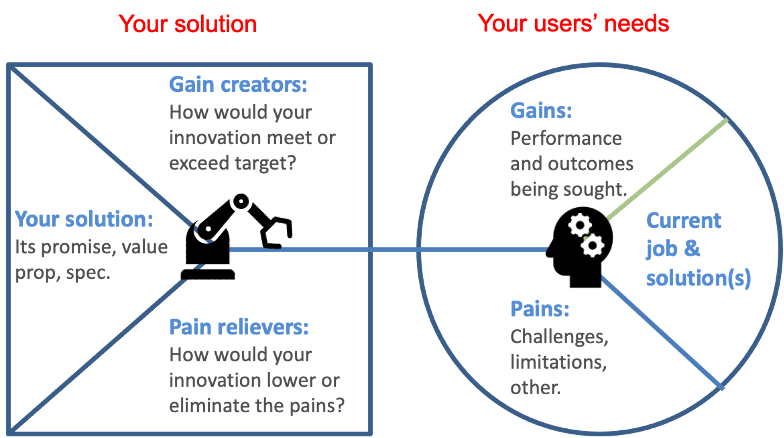
Entrepreneurship 101 now leads us with market need, not product design. Okay, you have a promising concept. Now, who is the target customer; what work are they doing; how can your concept bring gains to their undertaking of that work; how can your concept reduce pains in their undertaking of that work? Customer empathy is MBA-speak for the process of working through these questions and gaining a deeper sympathy for your customer and their job BEFORE focusing on product perfection.
An illustration of the customer empathy process looks like this:
Source: Strategyzer, The Value Proposition Canvas (adapted by the Interprize Group)
On Customer Compassion
Compassion: a sympathetic consciousness of others’ distress together with a desire to alleviate it. Marriam-Webster Dictionary
Compassion goes one step further than empathy. It requires action. Being deeply empathetic to the customer experience is a critical Step 1. Figuring out how to apply that understanding to optimize customer happiness is the compassionate Step 2. This is achieved through effective product/service design, delivery, support, and other business model elements that amplify user gains and reduce user pains.
As a new shiny gadget’s features and support align with the customers’ wants and needs we arrive at product-market fit (yet more business school speak). It’s a guiding principle to product design that requires constant validation and tweaks.
The Interprize Exception
Interpreneurs and entrepreneurs have a lot in common, particularly the desire to create something of great value and share it with the world. But we interpreneurs enjoy one crucial exception: the pilot customer is facing us in the mirror. Our fundamental motivation for the early mornings and late nights and hard-earned savings spent is in the search for purpose that is found through this sharing.
That search takes precedence over the market competitiveness and profit optimization of our shiny new gadget. And this liberating distinction gives us great license to create in our own image, to nourish our deepest passions, possibly and acceptably to the detriment of success as measured in conventional business terms. We call this hybrid principle product-passion fit. (That term is very much NOT business school speak.)
Examples may be helpful.
Marcia is a classic interpreneur. Her core career was spent mostly in marketing and sales in Silicon Valley’s tech world of venture-backed, high-flying startups. Living for the moment in Provence, she is an artist of impressive talent, and the sharing of this gift guides her encore career.
Marcia just completed my course on startup entrepreneurship at the ACM, working through 10 weeks of Bill Magill on mission statements and elevator pitches and product-market fits and business model canvases and fundraising, … and yes, also on customer empathy.
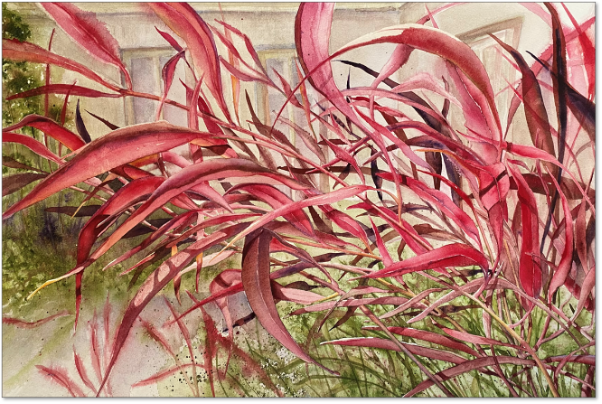
Jeux d’Ombres, Marcia Mason Speece
She was a great student and this grounding in basic entrepreneurship should enable even greater success with the spread and sales of her art. That is important, not only in helping pay the bills but validating her gift with the buying public. But Marcia will paint her garden watercolors irrespective of market success. It is her interprize, that prize within. It’s something she cannot not do. It defines who she is. It is her passion and through the sharing of this gift she finds purpose. Validation IS appreciated. Validation IS NOT the paramount objective. With her encore career she’s seeking product-passion fit.
My interprize is to write and stage rock dramas. I could plow ahead with a script and music and charge off to Broadway in search of open arms. Or, before setting pen to paper and fingers to keys, I could make an effort to understanding the arts of musical development and script writing, my specific audience (young, old, rockers, opera goers, theatre regulars, theatre newbies), what they want in a story (old stories reimagined, new stories freshly written), where they want to experience it (the stage, at home on a streaming series, watching a YouTube video, listening to Spotify, some mix of all), and so on.
My chances of getting staged are much higher if I first respect the craft that is my craft and the content qualities gaining market interest. But I will write these dramas regardless of their chances, and in my own voice. And I will not be limited to an algorithm’s guidance of what’s trending now. Writing music is something I cannot not do. I have finished one (click here for a listen to Last Night at the Ha-Ra if curious) and am working on my second rock drama now.
A final word on creative integrity.
Van Gogh had a wholly unique style. It is not that he was disinterested in what others were doing. On the contrary, his influences were many, including the Dutch Masters like Rembrandt and Hague School celebrities trending at the time. But unlike his contemporaries he remained ignored and famously broke for most of his life, and that speaks to his creative integrity. A healthy dose of customer empathy might have steered him in other directions. He chose to prioritize product-passion fit over product-market fit. The world is the better for it.
Starry Night over the Rhône, Vincent Van Gogh
Product-Passion Fit Experiment
(Refer to the diagram above if helpful.)
For your interprize concept:
1. Create a profile of your targeted customer archetype(s). Descriptors may include age, location, education, affluence, and other qualities that best characterize their particular attributes.
2. What jobs or activities are they doing related to your concept? For Marcia and her Watercolor Garden that list may include finding watercolor artists online (or locally) who have a particular focus on garden scenes, evaluating their work, buying and framing original pieces, having the same art rendered on cards and sacs, returning items, etc.
3. Build customer empathy by listing the pains they suffer and gains they would value while doing these activities. Apply customer compassion by turning this empathy into action items you can do to reduce these pains and amplify the gains.
Now, walk away from this activity for an hour or a day, then…
4. Reflect on how this act of compassion will impact your interprize project. In the perfect world they will align by reinforcing your sense of validation and accomplishment. More people finding and buying Marcia’s art. More musical lovers and critics finding and applauding my dramas. But the world is often not perfect. Making customers’ needs the overarching priority may pull you off your North Star (click here to refer to Experiment #3, Your Mission Definition). I may favor an abstract musical style that fewer people love. If crafting in that style for those few feeds my passion and gives me purpose, then I’ve maximized product-passion fit and the world will be better for it.
Our Mission at the Interprize Group – that North Star guiding every single thing we do – is to provide the resources, tool, courage, and community to pursue grand ambitions of deep personal meaning. To that end I’m offering 12 monthly experiments for 2023 that should help get you inspired, thinking creatively, and organized in these pursuits. This is the April edition: #4.
Our first 3 essays focused on the WHY (do something grand for your encore act) and WHAT (that might be). You may be still wrestling with these questions; they are big and it’s an iterative process. This experiment pushes on towards the HOW (you’ll do it). It will prompt a review of your Interlectual Property. My what, you ask? Onward.
Painting by Laura Pierre-Louis.
Interlectual Property (with an “r”) is a contrived term we’ve co-opted from the world of deep science startups. Merriam-Webster defines Intellectual Property (with an “l”) as any “property (such as an idea, invention, or process) that derives from the work of the mind or intellect.” Disruptive Intellectual Property is key to a deep tech startup’s competitive advantage and typically protected through patents.
Your personal Interlectual Property, or IrP for short, also includes creative ideas that distinguish your grand ambition from the fray – my hip laundromat will offer a beer bar, used book library, and live music! – plus other resources that support your pursuits: money, education, contacts, specialized equipment, location, etc. Getting these down on paper helps display what you have, and even more critically what more you need to develop a compelling, successful effort. (Fair admission: we just like the work Interlectual.)
Buckets
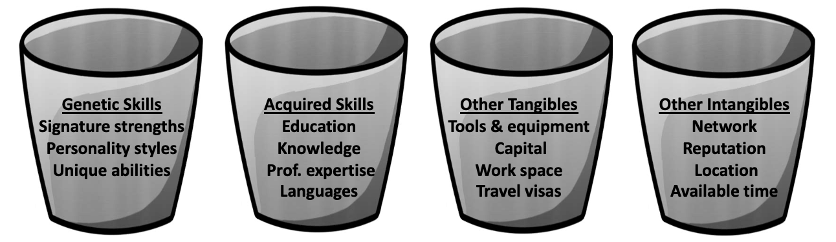
When surveying your many resources to exploit think about these 4 buckets as a starting point. The contents will differ depending on your own unique history.
Bucket 1 is a collection of your natural signature strengths, personality style, and unique abilities gifted from birth. Why identify your natural strengths? Playing to them will give you an inherent advantage from Day 1 and help advance your efforts more effectively, which feeds confidence, which encourages an even bigger effort; a virtuous cycle.
The great sages of optimism, such as Martin Seligman (“Flourish”) and Mihaly Csikszentmihalyi (“Flow”) agree that building on one’s natural strengths is key to personal growth and fostering authentic happiness. Knowing your strengths – natural and learned – also reveals the holes in your game, which can filled through purchase or additional training.
Many different evaluations have been developed to define and measure strengths and styles. Two that we like and use in our Life Leap Workshops include:
The VIA Survey of Character Strengths, available here at UPenn’s Authentic Happiness Center. This test provides a ranking of 24 signature strengths that define your authentic power base. Bravery, fairness, creativity, honesty, and 20 others are included.
The Enneagram Personality Test, available here at Truity. The Enneagram is a set of 9 personality types. Perfectionist, peacemaker, enthusiast, and 6 other classifications are included. You’ll find a bit of yourself in all 9, but one will capture your true signature style with startling accuracy. While Truity offers an online test for free I recommend having a professional take you through an evaluation for a much deeper and thorough reading. Contact me for a reference if needed.
Bucket 2 is a collection of those learned assets acquired through life. Some may prove essential to your encore ambitions, some not so much. It’s a valuable exercise to list them all. Your grand ambition in 6 months may be different than the one today, and some former skill sets may suddenly find new relevance.
Bucket 3 is a space for all other major tangible assets that have value, whether or not for the legacy project you’re considering. Money is always helpful, as is specialized equipment, especially for artistic endeavors.
Through a life of writing, performing, and recording music I have a collection of quality guitars, amplifiers, microphones, and recording equipment (my wife Alexandra had deep reserves of patience, definitely one of her signature strengths). This equipment is valuable for my encore ambition to get a rock musical produced and staged, and some pieces are indispensable as well for recording podcasts and short videos for my Interprize Group-related work.
Gratuitous photo of Aix-en-Provence.
Bucket 4 may require some creative thinking. Intangible assets in the business world include items like goodwill and unique knowledge/know-how that can’t be easily quantified. They are not physical and can be challenging to appraise. But there may indeed be real IrP value in the network of friends and professional contacts you’ve cultivated through the years, and the appreciation these people have of you. Hey,I’m working on a bold life ambition of very deep personal mean, … and I need a favor. Absolutely!
I live in a stunningly charming city – Aix-en-Provence – in one of the most appealing geographies in the world – the south of France. It’s a life choice, not strategic decision, but I would be wasting a fabulous asset if I didn’t leverage this location for Life Leap Workshops and other gatherings. It’s a big selling point that has an incremental cost of 0 to me (I’m living here anyhow). People just naturally want to visit. No arm twisting required. Put it down as an intangible!
Last month we talked about different experiments you can run to bubble up ideas on purposeful legacy ambitions. By now you should have at least a solid sense of Mission, a North Star piloting possibilities and plans. This experiment will reinforce those considerations by identifying the resources you can draw on now and those you’ll need to acquire in that pursuit (or pursuits if multiple).
Create your 4 bucket lists of skills and assets as outlined above. Take time to fill them thoroughly with the major assets you have acquired through life, including both those that should be helpful with current ambitions, and those that are not at the moment, but may prove valuable in the future.
Revisit your Mission Statement and motivations from Experiments 1 – 3 and identify those assets listed that are key in the pursuit of your Interprize; your bold life pursuit.
Create a new list – of assets needed but not yet acquired – and determine how you can attain them: buy them, learn them, ask others who have these skills or assets to join your effort, or other options.
Formalize you IrP strategy:
IrP you have
IrP you need
Your plan for filling in the holes
Don’t avoid leaning on your community of friends and family for support strengthening your abilities and assets. Study after study have shown the importance of personal relationships in building optimism and life enrichment, including this recent 85-year definitive study by Harvard (click here for the article in the Atlantic). If they love you they’ll want to help, … and they do.
There is no greater agony than bearing an untold story inside you. – Maya Angelou
This is #3 of 12 experiments for the year, offered to get you inspired, thinking creatively, and organized in the pursuit of bold life ambitions of deep personal meaning. Experiments 1 and 2 concentrate on the big question of WHY (aspire to live and leave a life respecting your greatest gifts and passions). They provoke you to think about life – your ideal versus the current version – and death – those things for which you want to be remembered as you pass into the great goodbye.
This March Experiment starts the migration of WHY to WHAT. If you’re still reading these essays then you’re likely loath to the idea of retirement years spent in the wading pool. That deep end of the grand basin feels risky, but damn if that diving board doesn’t look fun. WHY make the effort to mount the board, muster some courage, and take the leap? WHAT will you find at the bottom of the pool? Onward.
Is it important dive deep, especially if after a life of impressive achievement? I argue that it is for at least 4 reasons:
1. Midlife is the best moment to dream big and realize your authentic self. You likely have some stores of savings, the kids are gone, your network is extensive, health is still good, mind is still sharp, time is available, and your life experiences have a bestowed a wisdom to which your younger self had no access. Are you going to waste this golden moment?
2. Your accomplishments to date, impressive as they may be, may not reflect the untold story inside you. Amazing mom, corporate CEO; both and many titles in between are impressive laureates. If that’s all that needs be told and you’re fine with that résumé on your stone block, god bless and job well done. If not, there’s no better time to start on a new epithet. (See point 1.)
3. You’ll likely live a longer, richer life. Study after study of repeatable, empirical evidence reveals that pursuing authentic life purpose is a key to happiness, good health, and more days on top of the dirt. Just a few sources include centers of research led by Martin Seligman (UPenn), Sonja Luybomirsky (UC Riverside), Barbara Fredrickson (UNC Chapel Hill), and the Greater Good Science Center at UC Berkeley. The results of an 85-year Harvard study published just last month show that the essential ingredients to longer, happier lives orbit around positive relationships. And one key component of these is the personal growth enjoyed from the pursuit of purposeful life goals, shared with those you love.
4. The world needs your gift. There is so much beauty and so many problems in the world today. Perhaps your gift is artistic expression, perhaps it’s helping people in need, maybe it’s retracing the voyage of Kon-Tiki in a balsa log boat. Regardless, we all benefit. Jimmy Carter stands at the gate to ascension as I write this note, in hospice care back in Plains, Georgia. He was President of the United States; the most powerful man on earth. Now that’s a colossal accomplishment on which to call it a day and retire to the Palm Beach club set. But Jimmy’s legacy had only begun. Nobel Prize recipient, tireless human rights and healthcare advocate, green energy pioneer, Habitat for Humanity founder, and loving husband and dad. We’re going to need a bigger headstone! He will leave this world a much, much better place for all of us to live.
What to do, what to do
Some of us know well our deepest passions and where purpose resides. We understand our gifts, have dabbled with daring projects, and hold a solid sense of how to make a difference. Some of us have no clue. The most of us are somewhere in between.
There are an endless number of books available on uncovering your purpose (see additional reading below). I offer here 3 exercises on Options, Motivations, and Activities that will be helpful in surfacing possibilities should you be in that not really sure category.
Exercise 1: Options (let’s boil the ocean, shall we?)
1. List all previous existing ideas of hobbies, passions, or curiosities that you’ve considered pursuing when you had more time.
2. Identify enjoyable activities from your career. What parts of your jobs did you love doing (as opposed to those you dreaded)?
3. What activities put you in a Flow state; that is, when engaged in them your strengths are challenged and mind 100% immersed, numb to other distractions, and you lose all sense of time.
4. What’s on your bucket list if you have 12 months to live?
5. What types of roles, activities, or responsibilities do you want to avoid?
6. Compare these lists and look for themes.
Exercise 2: Motivations
What is driving you develop a greater sense of purpose? Why commit your energy, spend your savings, and abandon the easy life for a more deeply engaged life? What are your motivations?
This is a short list of 33 possible motivations that may be driving you, just a slice of total possibilities. Create your own, select 5, and look for themes.
Exercise 3: Activities
Create a table of activities from your career or life roles and identify those that you enjoyed and those that created the greatest discomfort. The table should include your job/role title, activities performed in each, and focus of those activities. Circle the activities you enjoyed and strike through those that you did not. Look for themes.
In my professional career I was an analyst, investor, and professor and I present my own table here as a sample.
Your Mission
These exercises may not uncover a specific project, but should be effective in setting your North Star. In the business world this is referred to as a company’s Mission and revealed through a Mission Statement. (Some life coaches refer to it as a Vision Statement; take your pick.) It has little to do with what a company actually produces, but succinctly encapsulates its core customer value. Three examples:
To create happiness for people of all ages, everywhere.
To accelerate the world’s transition to sustainable energy.
To encourage and enable the pursuit of bold ambitions of deep personal meaning.
Nowhere here are specific products or services mentioned. Nothing about theme parks or electric vehicles or life leaping programs. But everything these companies do will align with their Mission Statements. If not, either the statements or the offerings must be reconsidered.
You should be ready to take a first pass at your Mission Statement if you’ve worked through the exercises above. What value will you offer the world and how will it tell that story inside? Focus on value not product or specific project. Think about your customers. There may be millions, there may be just 1: you. This is your life, your bold ambition, your interprize. What will it give us? Where will it lead you? What’s that North Star?
Additional reading
There is an endless list of books written on the topic of finding life purpose. No single one is considered the definitive work. I’ve read just a few and these are some titles I found particularly helpful:
Finding Your Element: How to Discover Your Talents and Passions and Transform Your Life. – Ken Robinson
The Encore Career Handbook: How to Make a Living and a Difference in the Second Half of Life. – Marci Alboher
Suggested Song: Downtown Train, Tom Waits
Suggested Drink: Thurston Howl, rum, brandy, gin, pineapple and grapefruit juices. (to sooth those weathered pipes)
I’ve wanted to be rock star since I was young. I gave it the old college try as a teen, then surrendered to the odds and went off to college. But I never gave up on the dream. I kept on writing music and making bedroom demos through my 20s, and recorded a proper studio album in my 30s. It was a decent effort, but my voice just didn’t have that edgy rock n roll bark that I so loved hearing in the greats: Daltrey, Waits, Cobain, Bon Scott. I couldn’t find my howl.
A lot of us are inspired but mediocre at things we really love, particularly when we’re young. Passion and effort aren’t always enough, unfortunately. But there are plenty of examples of mediocrity flowering into something truly special in later years. Consider Czech composer Leos Janacek. He penned a respectable piece at 22 in the late 1800s, and then spent his next 30 years mostly doing folklore research. Janacek kept plugging away in his spare time but didn’t find real renown until 62, with the completion of his opera Janufa, to be followed by Sinfonietta and then many other classics.
Why his later-in-life bloom? Maybe he finally had time on his hands to immerse more deeply, or it was the continued honing of his talent, or the inspired provocation drawn from his ache for the beautiful Kamila, married and 35 years younger, for whom he took a hard tumble just about the time Janufa was in work. Love bloomed, he soared, the rest is for us to enjoy.
Another good example is Charles Bukowski. At 24 his “Aftermath of a Lengthy Rejection Slip” got published to some decent reviews. Then he went on a prolonged bender and deep dive into the seedier side of life. Like Janacek, Bukowski kept at his craft but had little to show for it. His real break through came at 51 with “Post Office,” which he wrote in 3 weeks after quitting the Postal Service in LA as a carrier. (I picked up a copy at City Lights in SF earlier this year. What a great read.)
I was at a Chagall exhibit in Aix-en-Provence last week, at the beautiful Hôtel Caumont in the center of town. Chagall established himself as a transcendent and successful painter early in life, and unlike Janacek and Bukowski kept the acclaim rolling. But what I admire most about Chagall is his leap into distinctly different and challenging forms of art in his later years: ceramics and stone sculpture and stained glass, starting in his mid 60s. You think I’m this, but now I’m that. Allez allez, keep up!
Maybe you’re in your 50s or older and thinking that the window of passion possibilities has long closed. That comes down to the commitment you are ready to make and embarrassment you are willing to suffer. But who cares about embarrassment? No one will say at your funeral, yeah she was great at X but really embarrassed herself at that Y thing she so loved. No, a best friend or sibling or child will say that you had a real passion for Y and immersed yourself deeply in it. You will produce something authentic that people will either embrace or reject, but everyone will respect the effort.
I went back into the recording studio last year with a binder full of songs and a talented bunch of musicians. A new album after a 25-year pause, this was my Janacek moment in more ways than one.
Why now? My confidence was buoyed by the inspired material and quality of the crew, but more than that my voice had taken on, finally, enough gravel to sing what I wanted to hear. Age and more than a few Bukowski evenings had lined those silky pipes with a rough patina of smoky leather. It just wasn’t my time at 30. It might be now. I’ve found my howl.
Suggested Song: Wall of Death, Richard & Linda Thompson
Suggested Drink: a frothy pint of Guinness. Let the toasts begin.
I was in Nashville last week for a funeral and had been invited to say a few words on behalf of my family. This kind of duty can make people squirm. To be honest I don’t mind it. It provides a rare chance to reconnect with that soulful raconteur within, a genetic companion from my paternal grandfather, who was an Irish preacher of the good word.
Toasts spill out with ease, but eulogies can be tough to get right when the material is thin. This was not the case in Nashville. In fact my challenge was less what to say and more what to leave out. For my oldest sister had suddenly departed a life of beautiful breadth and depth. She was a traveler and seeker, a generous giver and curious student, strong when strength was needed, vulnerable when our own failings were being shared.
Life is short so enjoy it now.
This popular call to carpe diem always gets a good airing at funerals and wakes. It never quite hit the intended mark for me.
Life is short. Not necessarily. All that we know for sure is that none of us have any idea for sure. Children die unexpectedly and wrinkled up folks live past 100 and most of us get plunked down somewhere in between.
I never heard my grandmother Magill say life was short. For her, life was one long adventure. She escaped the crossroads of a Pennsylvania village and ventured off to college at the dawn of the Roosevelt era – Teddy that is – when a woman’s place was well understood: hands on the pot and babies on the hip. Work and wonder would carry her on to Puerto Rico, up to Manhattan (where a degree from Columbia was added), down to deep, deep Alabama, and then overseas to the Egyptian Sudan where she married my grandfather; the one and the same mentioned above.
Grammy lived to 100 and my sister to 67. I lost a close childhood friend at 19. We can’t waste time trying to size up our allotted sand in the hourglass. Life is unpredictable. Isn’t the key to get in a grand story worth sharing?
Enjoy it now. I don’t propose suffering now, but there is more to life than margaritas deck-side. If we want our eulogists’ writing assignment to be easy then we need lead lives worth retelling. And we’re all going to have someone retelling our stories, right? No one gets out of here alive.
So my point is this: go bold, go deep, do it now. Your remaining days may not be short. You may have decades left to create a magic that reflects all the best of your gifts and passions. Then again, you may have one more day. Be the author of the narrative you want delivered on that sunny day in the chapel, or it may fall to someone much less vested in making you sound amazing. Offer a highlight reel that can’t be cut and cropped; one that keeps everyone roused and laughing between tears.
Put a pint in my hand and I’ll stay full of barley-inspired toasts to you for many a round. But if you want deeper reflections on a life that truly mattered, that left everyone who knew and touched you in a better place, take the leap now. Uncover, develop, and share that bold gift as only you can.
Dedicated to J. Catherine. You made my job so easy sister.
Suggested drink: Champagne (your favorite, it’s the holidays!)
Suggested song: You Get What You Give, The New Radicals
What is your big gift for the holidays? No, I don’t mean what are you getting, I mean what are you offering? We each have a special gift and an obligation to share it with the world. I believe this, do you?
The self-improvement aisle is lined with books on finding purpose in life. The authors treat its fulfilment as a key to happiness and benefit to you, the seeker. But isn’t it more importantly your obligation? If you’re like me you’ve sucked a hell of a lot more out of this world than you’ve put back: a half-life of durable and consumable stuff, art and music, food and wine, the love and generosity of others, …everything that nourished your life and gave it definition. Now is the time to reverse the net flow.
It’s an ugly, uncertain time we live in today where ignorance is celebrated and consumerism is king. Bigger, faster, harder, wrapped in a tidy bow of obliviousness. These hallmarks of the moment will end soon enough, one through the will of the many, and one by the hammer of nature. But it won’t be pretty.
More than ever we need enlightenment and beauty to counter the tide, … and this is where your obligation begins. You have an amazing, inimitable gift to offer the world. It’s unique, a result of your one-of-a-kind DNA predisposition plus singular history of upbringing, education, experience, and personal community of friends, family, and colleagues. No one else has the exact same set of resources, skills, and interests. Align that with an ambition of deep personal meaning and you are better prepared and motivated than anyone else on this planet to do at least one incredible thing, to offer at least one amazing gift.
Sunsets are for Sissies
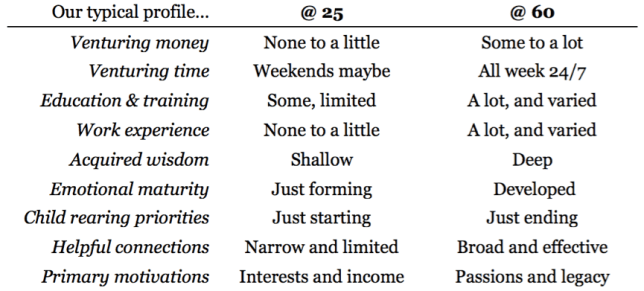
I wrote an essay with that title in 2015 (to read click here) in which I argued we are better prepared at 60 to pursue something truly significant and life defining than at 25. We have more time, more experience, more money, and a lot more maturity, as summed up in the following table.
If you are at midlife and considering retirement and what next?, now is not the time to downshift into a recliner by the sea, comparing daily golf scores and evening sunsets. You’re better prepared then ever to leave your mark on this world, and that’s not just a pleasant dream to imagine over icy margaritas, that’s your gift and obligation. Allez!
It is not true that people stop pursuing dreams because they grow old, they grow old because they stop pursuing dreams. – Gabriel García Márquez
We humans are a curious species. Half of our lives are spent developing into interesting, capable creatures. We get degrees, build careers, save money, acquire knowledge and experience, hone interests, learn from mistakes, gain compassion and learn to love. From molehill to mountain we slowly, steadily grow our possibilities and potential. And at the peak of our prowess we downshift to the “good life” and atrophy into a retiring sunset.
Wasted potential is everyone’s loss. We harangue the young about squandered time when their hourglass is mostly full, and then become the worst violators when ours is half empty. At a time when creativity in all its forms is most needed and appreciated on this planet, the surrender of our talents to the porch swing and wine cave is a communal loss.
How do we stack up at midlife against our younger selves in the capacity to achieve great things? The following table displays a brief summary.
Oh to be young again, just starting out and facing adventure, pursuing such promise, the exciting unknown of the roads ahead. Most of us were balancing a host of obligations and still seeking our balance. We were finishing studies and starting careers, probably the first of a series as we pinballed through different ideas and experiences. We were discovering ourselves and uncovering new interests, but generating income was the primary concern and motivator. Time was consumed with work and kids, and the emotional child inside lingered well past the twenties (speaking for myself). Our time and resources for pursuing grand ventures outside conventional careers were limited in all manner of ways: our finances, support networks, bases of knowledge, and emotional maturity.
These factors that hobble our passion plans start to dissipate by midlife, leaving us well armed for the pursuit of grand ambitions. Kids graduate from our daily lives at about the time our core careers are winding down, leaving us with more time, fewer distractions, and more disposable income. We have been well educated, trained and retrained through our university and working years, gained knowledge, and as importantly gained perspective and balance. Our rolodexes are full of people who can help, or people who know people who can help. At midlife we have the time and resources, the maturity and experience, and we have interests that are blossoming into real passions. This is when we retire to porch swings and sunsets?
We humans are a curious species, it is true. Our interests shift to the deep end of the pool with age, the lure of the profound not marked firstly by splashy income, but personal achievement, meaning, and the possibility of leaving something big behind. We’re taking better care of physical and emotional selves than did our parents; 60 is the new 40; interpreneurs are the new entrepreneurs. Now is the moment to accelerate into the experience, to dive deep. There will be time for sunsets down the road.
Suggested drink: Rum punch recipe, pineapple juice, orange juice, Bambarra rum, grenadine
Suggested song: Kokomo, Beach Boys
We descended on Turks & Caicos last week to celebrate the 50th birthday of a great friend. There were 25 or so in the group, arriving in clumps as summer schedules allowed, couples and singles and kids in tow for the family few.
The Caribbean is wilting in July and between the pool and beach we were growing gills by the end of the week. Constant hydration was le rigueur, with a steady water infusion plus rotating lineup of cold Presidente beer, rosé wine and local rum punch as the sun dipped from noon to night.
Sea life
Turks & Caicos has the third largest coral reef in the world. Its beaches have been voted the most beautiful, it’s diving the most stunning on this planet by Tripadvisor and others. The water is warm and calm and visibility exceeds 100 feet, sometimes more. Needless to say the boating and snorkelling is unforgettable.
The variety of sea life darting over and through the vibrant coral is a visual feast, from spinning swarms of tiny forage fish to solitary predators gliding majestically over the sandy floor. Blue tangs and bar jack, eagle rays and lemon sharks and barracuda, parrotfish and trumpet fish and damselfish, … and conch. Oh the conch! This large spiral sea snail is the sought-after celebrity of Turks & Caicos and served in most every eatery, as raw ceviche, over tender leaves of salad, deep fried into fritters, however you enjoy it. It’s the royal plate for the well-heeled to the flip-flopped. It’s colorful, delicious, and makes for one hell of a sea horn. Yes, by week’s end we grew gills and had conch coming out of our ears.
Land life
The birthday party group at Turks was as diverse as the fish in the crystalline blue sea. We were old and young, gay and straight, black and white and beige and olive, carnivores and herbivores and pescetarians, liberal and conservative, wealthy and not nearly so, some overworked and a few unemployed, flying in from all points on the globe. Among us were doctors and consultants and professionals of every stripe, restaurateurs and a bartender, jewelry shop owners and a jewelry designer, musicians and writers (who isn’t these days?), a physical therapist and a garbage man, students and grandmothers. Who am I missing?
I’m convinced that this variety was key to the unending smiles, hugs, and the warm and familial vibe of the amazing week. We open ourselves to the diversity of colors around us and our worlds become richer and vastly more fascinating. Among our immediate and extended networks, and networks beyond that, we have the diversity of the boundless sea. Why limit our reach to fish of our own color and stripe?
The merits of openness extend beyond simply more interesting rum cocktail conversation. Many of us have grand ambitions that profit from a wide spectrum of connections, experiences and advice from all walks of life and corners of the sea. Limit your network and you limit your possibilities. Teach, learn, grow, … now where’s that rum punch?
















 Land life
 BILL MAGILL